



Is Glyceryl Stearate SE Safe for Skin Care Formulas?
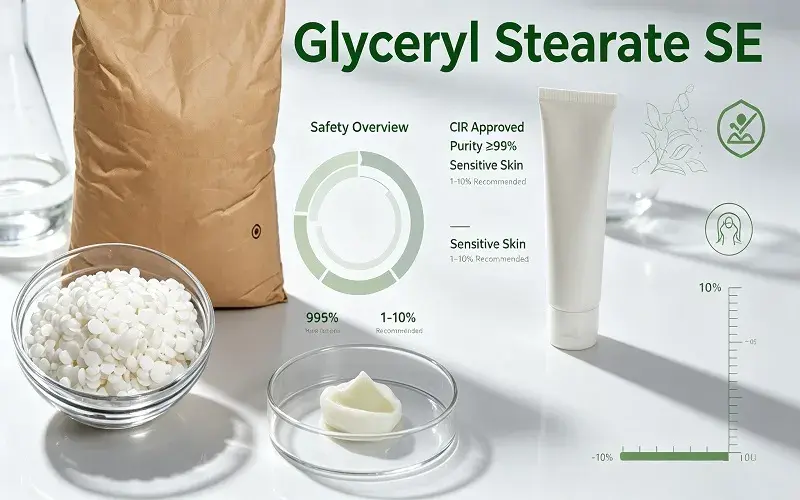
Glyceryl stearate SE is regarded as safe for use in skin care products. An expert panel from the Cosmetic Ingredient Review (CIR) looked into the safety of glyceryl stearate and related esters. They found that at the concentrations used in finished products, these esters are not irritating or sensitising. A single ester of glycerin and stearic acid (CAS 85666-92-8). What it says: ≥99%. Uses: This one-part mixture of glycerin and stearic acid has been used safely for a long time in medicine and cosmetics. It can be used at the recommended amount of 1% to 10% even in products for people with sensitive skin because it doesn't cause many allergies.
Understanding Glyceryl Stearate SE: Composition, Functions, and Safety Profile
What Exactly Is Glyceryl Stearate SE?
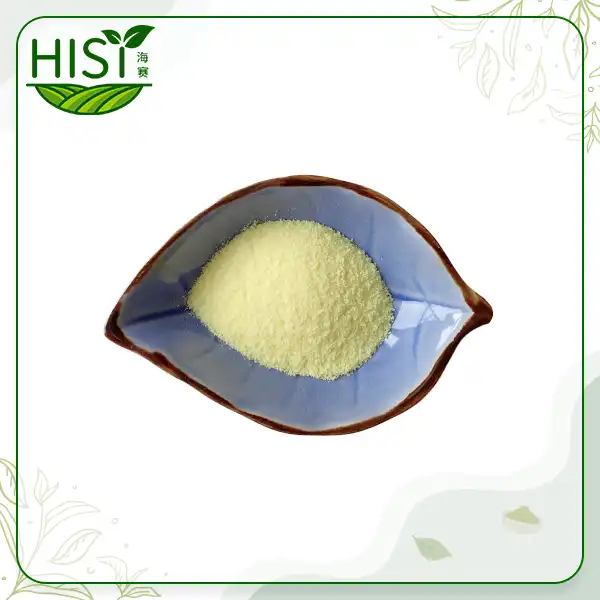
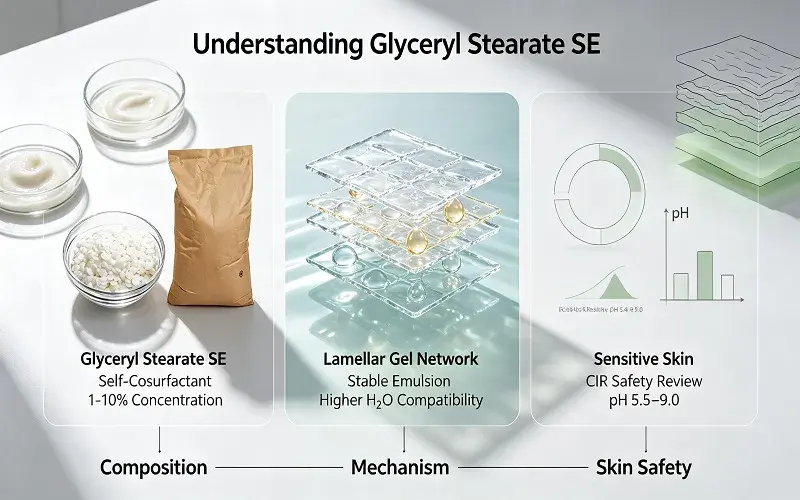
Glyceryl stearate SE is a kind of glyceryl monostearate that may be combined with itself. If it is labelled “SE,” it contains 1-5% sodium or potassium stearate, a natural co-emulsifier. This modest addition in O/W (oil-in-water) systems eliminates the requirement for a separate emulsifying agent. It appears as white to yellowish granules and works well in many different cream, lotion, and serum formulas at dosages of 1% – 10%.
How Does It Function in a Formula?
In emulsions, glyceryl stearate SE forms solid lamellar gel networks, which provide improved shear-thinning properties and long-term structural stability of the emulsions. This prevents phase separation, a frequent site where ordinary grades of glyceryl stearate fail. It is significantly more hydrophilic than the non-SE version (HLB value approximately 12.0) and hence functions well in water-continuous systems. "Formulators of barrier creams, nighttime moisturisers, and medicinal external bases always remark that it contributes to the smoothness, which is a big technical benefit.
Is It Safe for Sensitive Skin?
Researchers have determined that this chemical, Glyceryl Stearate SE raw material wholesale, is usually harmless. The CIR investigated glyceryl stearate compounds and found no evidence that cosmetic usage levels increase skin sensitivity or induce mutations. It is best stable between pH values of 5.5 and 9.0. Note to formulators: if the pH is below 5.0, the anionic soap component may be less stable. For sensitive skin creams, concentrations between 2 and 5% reduce the risk of moderate occlusion-related reactions.
Comparing Glyceryl Stearate SE with Alternative Emulsifiers
SE vs. Non-SE Glyceryl Stearate
The distinction is operational independence. Standard glyceryl stearate (NSE) requires a secondary emulsifier to get a stable oil-in-water emulsion. This increases the number of processes in the production process and the chance of compatibility problems. The emulsification job is done by the built-in soap portion of glyceryl stearate, which makes the recipe simpler. This means that for B2B enterprises that work on a large scale, there will be fewer SKUs for raw materials and easier manufacturing methods.
SE vs. Cetearyl Alcohol and Emulsifying Wax
Cetearyl alcohol and emulsifying wax are common alternatives that are considered safe. Cetearyl alcohol is a thickening and co-emulsifying agent; however, it is typically necessary to combine it with an emulsifier of the surfactant type. Emulsifying wax is likewise stable, and is commonly made out of cetearyl alcohol and polysorbate 60; however, it does include ethoxylated chemicals that some clean-label manufacturers avoid using. Glyceryl stearate se, derived from vegetable sources, is more favourable for natural-origin and RSPO-compliant product lines.
Advantages and Limitations
Glyceryl stearate SE is a wonderful ingredient for formulation work. Knowing both sides helps buying teams make wise decisions. These are the most significant performance elements to consider:
- Self-emulsifying: The integrated anionic part means no need for a co-emulsifier giving you a shorter raw material list, less variables in manufacturing.
- Lamellar network formation: Provides a robust emulsion structure that is resistant to phase separation during temperature changes and high shear manufacturing conditions.
- Natural origin compatibility : From vegetable origin and compatible with RSPO Mass Balance certification, to enable clean-label and sustainability claims in the US market.
- Cationic incompatibility: The anionic soap fraction can compound with cationic actives such as BTMS, and hence compatibility testing is essential prior to mixing these products.
These factors show that glyceryl stearate SE works well for most on-and-off-duty skin care uses. However, formulators who work with cationic conditioning systems should plan to test for compatibility early on in the development process.
Procurement Essentials: Buying Glyceryl Stearate SE for B2B Skincare Manufacturing
Supplier Benchmarks and Documentation
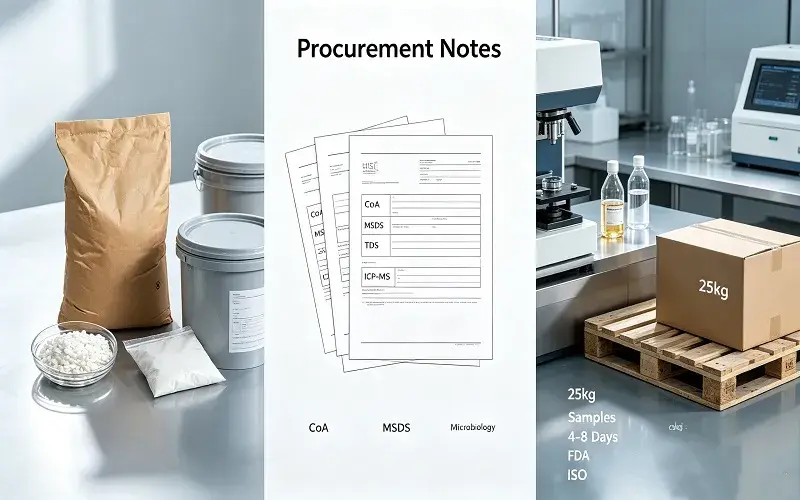
Glyceryl stearate se two of the greatest standard goods for big scale are Croda’s GMS30 and Monoester SE. These are the parameters that professional B2B buyers use to assess providers. Buy teams should at minimum be asking for a Certificate of Analysis (CoA), Material Safety Data Sheet (MSDS), Technical Data Sheet (TDS), heavy metal test findings (ICP-MS), and microbial limit testing data. To assess the efficacy of the emulsification, the monoester concentration (typically between 32 and 52%) is checked by gas chromatography.
Pricing, MOQ, and Logistics
Glyceryl stearate se is usually sold in 25 kg drums with two plastic bags inside and a paper drum on the outside. This is the normal way to package the product so that it stays intact while it's being shipped. Prices depend on the purity level and the number of items ordered. For material that has been confirmed to be ≥99% pure, buyers should get cheap quotes along with full certification packages. From well-known manufacturers, delivery times of 4 to 8 business days are possible. It is common to ask for free samples before placing a large order, which protects the formulation investment.
Compliance Considerations for the US Market
Skincare companies in the US need to make sure that the company that supplies them with glyceryl stearate se is registered with the FDA and follows all of the safety rules set by DSHEA and the Cosmetic Ingredient Safety Act. HACCP and ISO certificates show that the production process is being controlled. RSPO-certified vegetable origin is a must for brands that want to get organic or natural approvals. Another level of verification that professional procurement teams shouldn't skip is testing against more than 500 pesticide panels and making sure that the limits set by REACH for heavy metals are met.
Best Practices for Formulating with Glyceryl Stearate SE in Skincare Products
Temperature and pH Management
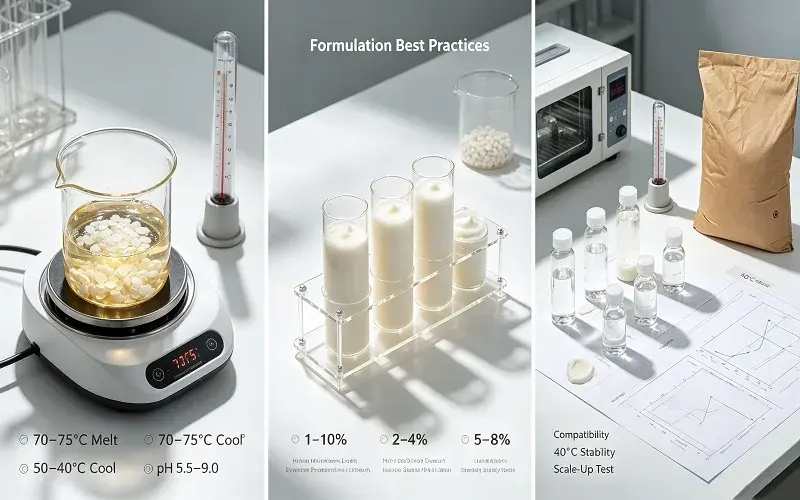
Before combining with the aqueous phase, glyceryl stearate SE should be added to the oil phase and heated to about 70–75°C to melt completely. It is during the controlled cooling stage, between 50°C and 40°C, that the lamellar crystalline network forms. If there isn't enough pressure during this shift or the mixture cools too quickly, the networks won't form properly, which will make the emulsion unstable. The emulsifying function of the soap fraction is kept when the mixture pH stays between 5.5 and 9.0.
Concentration Guidelines by Product Type
The suggested range for use is 1% to 10%, and the exact goal depends on the type of product. Light moisturizers used every day usually work well at 2 to 4 percent. High-viscosity barrier creams and pharmaceutical topical bases may need 5 to 8 percent. At the upper end of the range, glyceryl stearate se stabilizes the pigment-loaded surface well, which is good for sunscreens with a lot of zinc oxide or titanium dioxide. Going over 10% doesn't make it more stable proportionally, and it might make your skin feel waxy, which isn't what you want.
Compatibility with Actives and Preservatives
Formulators say that glyceryl stearate se works well with niacinamide, hyaluronic acid, plant extracts, and common cosmetic preservatives like phenoxyethanol and sodium benzoate. Problems with compatibility mostly happen with cationic systems and vitamin C products that have a low pH. The best way to be sure of how a new formula will work with this emulsifier in the long term is to test it on a small scale at 40°C for four weeks before increasing production.
Conclusion
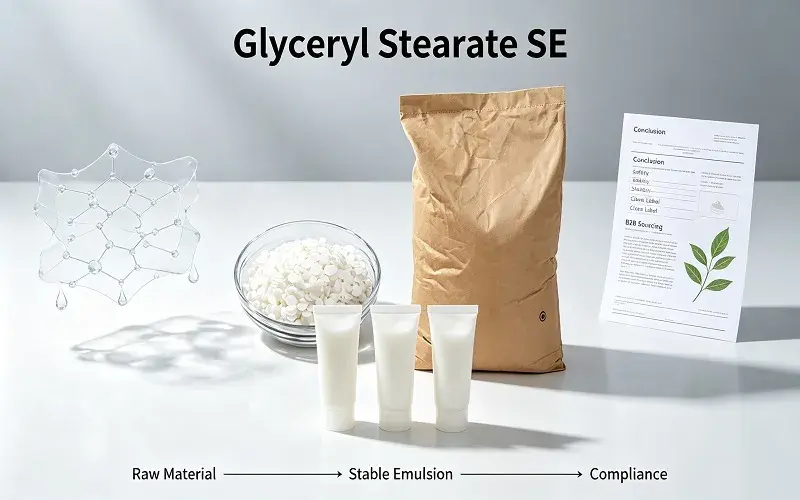
Glyceryl stearate SE has an established safety record, functional versatility, and reliable performance across a wide range of skincare applications. Its self-emulsifying chemistry reduces formulation complexity, its lamellar network structure delivers physical stability, and its vegetable origin supports clean-label positioning in the US market. For B2B formulators and procurement professionals, the key steps are sourcing from a certified manufacturer, verifying documentation thoroughly, and running stability testing before scale-up. This ingredient earns its place in modern cosmetic manufacturing through consistent, evidence-backed performance.
FAQ
Is glyceryl stearate SE suitable for vegan skincare lines?
Yes. When sourced from vegetable-derived (RSPO-certified) raw materials, glyceryl stearate SE qualifies for vegan formulations. Buyers should request a written declaration of vegetable origin from the supplier and confirm no animal-derived stearic acid is used in production.
What certifications should I request from a supplier?
Request CoA, MSDS, TDS, FDA registration documentation, HACCP and ISO certificates, pesticide residue screening reports, heavy metal test results, and microbial limit analysis. For the US market, RSPO certification and REACH compliance documentation add further assurance.
Can glyceryl stearate SE be used in sensitive skin products?
Yes, within the 2–5% concentration range and at pH 5.5–7.0, it shows minimal sensitization risk. The CIR review supports its safety at cosmetic-use concentrations. Patch testing during product development remains advisable for products targeting reactive skin types.
Why did my emulsion separate after manufacturing?
Phase separation most commonly results from insufficient mechanical shear during the 50°C–40°C cooling window, a cooling rate that is too fast, or a pH below 5.0 that destabilizes the anionic soap fraction. Reviewing your cooling protocol is typically the first corrective step.
Source Your Glyceryl Stearate SE Supplier Directly from Hisy
Glyceryl stearate SE can be used in vegan products as long as it comes from RSPO-certified vegetable-based raw materials. Buyers should ask the seller for a signed statement that the product comes from vegetables and make sure that no stearic acid from animals is used in the production process. To get a price and start the buying process right away, email our team at sales@hisybio.com or go to hisybio.com.
References
1. Cosmetic Ingredient Review Expert Panel. Final Report on the Safety Assessment of Glyceryl Stearate and PEG-n Glyceryl Stearate. International Journal of Toxicology, 1982.
2. Fiume, M. M., et al. Safety Assessment of Glyceryl Esters as Used in Cosmetics. Cosmetic Ingredient Review, 2018.
3. Loden, M., & Maibach, H. I. (Eds.). Dry Skin and Moisturizers: Chemistry and Function. CRC Press, 2000.
4. Eccleston, G. M. Functions of Mixed Emulsifiers and Emulsifying Waxes in Dermatological Lotions and Creams. Colloids and Surfaces A, 1997.
5. Rowe, R. C., Sheskey, P. J., & Quinn, M. E. (Eds.). Handbook of Pharmaceutical Excipients. 7th ed. Pharmaceutical Press, 2012.
6. RSPO (Roundtable on Sustainable Palm Oil). RSPO Mass Balance Certification Standards for Oleochemical Derivatives. RSPO, 2020.