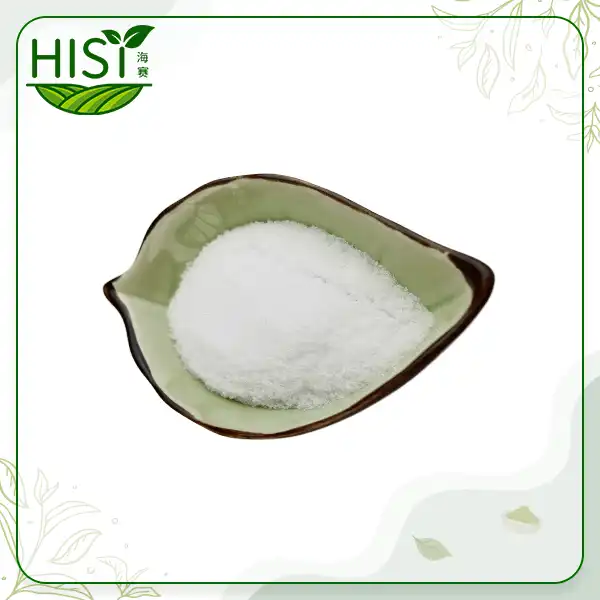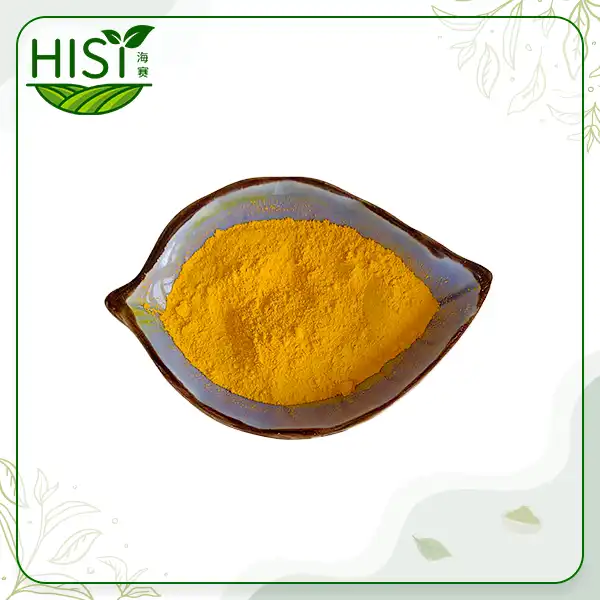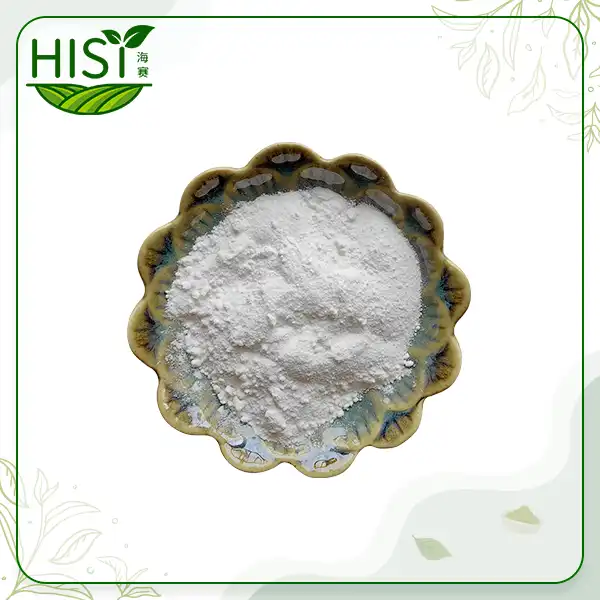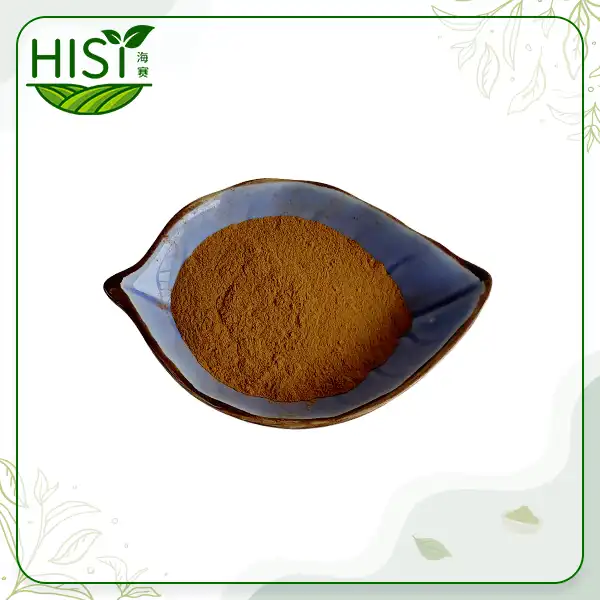




What are the main application scenarios of lycopene powder?
Lycopene powder serves as a versatile ingredient across multiple industries, primarily applied in dietary supplements for prostate and cardiovascular health, functional beverages requiring cold-water dispersibility, cosmetic formulations targeting photoprotection and anti-aging, pharmaceutical preparations demanding high-purity specifications, and animal nutrition products. Derived through fermentation technology using non-GMO Blakeslea trispora strains, this deep red powder offers consistent quality without the volatility of tomato extraction methods, making it the preferred choice for manufacturers seeking batch-to-batch reliability in nutraceutical, beverage, cosmetic, and pharmaceutical applications.
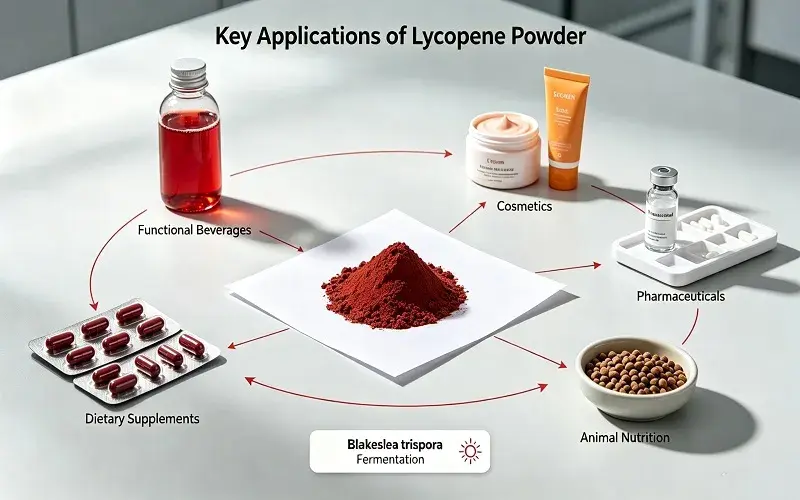
Main Application Scenarios of Lycopene Powder in Industry
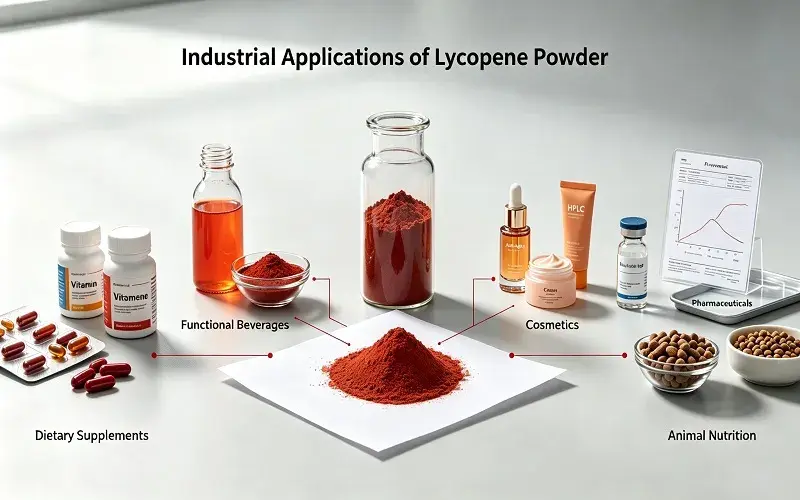
This lycopene powder element is very useful because it can be used as a bioactive substance, a natural colorant, and a stabilizing agent all at the same time. Understanding the specifics of an application helps procurement teams choose the right specifications to meet their product development goals.
Nutraceutical Supplements: The Largest Market Segment
The main way people buy it is through dietary supplements, especially in the US, where demand is driven by awareness of prostate health. Softgel pills usually have 10 to 30 mg of lycopene powder per dose. Vitamin E, selenium, or saw palmetto extract is often added to them to make them work better. Our 10% powder specification works great for these uses because it gives enough concentration while keeping the price low enough for mid-range supplement brands.
Our 98% ultra-pure grade is needed for high-dose medicinal formulas that aim to treat illnesses. These goods are used in study and high-end supplement lines where proof of effectiveness is very important. The pharmaceutical-grade purity gets rid of any interference from carrier materials during stability studies and clinical trials. This meets the strict needs of institutional buyers and research groups.
Another area that is growing is cardiovascular health. Scientific material shows that lycopene powder helps keep cholesterol levels and artery flexibility in a healthy range. Supplement companies that are making heart-healthy formulas are putting omega-3 fatty acids, CoQ10, or plant sterols in them more and more. Our technical team helps with compatibility testing to make sure that the ingredients stay stable when they are mixed for the whole shelf life of the product.
Functional Beverage Applications: Solving Dispersion Challenges
An ongoing technical problem for beverage makers is adding lipophilic nutrients to water-based matrices without changing the appearance, taste, or stability of the drinks. Our CWS 5% and CWS 10% microcapsule powders are made to meet this need. The microencapsulated format dissolves right away in cold water, so there's no need for high-shear mixing or co-solvents, which can slow down production.
Companies that make sports nutrition have started using this technology to make recovery drinks and hydration products with added antioxidants. It looks nice and works well, and the natural red-orange color makes it look good. Because of clean label rules, formulators don't use synthetic colorants. This makes fermentation-derived lycopene powder a desirable dual-purpose ingredient that meets both nutrient and visual goals.
Lycopene powder's ability to protect against UV rays is used in the popular "Beauty from Within" drink trend, which is especially strong in Asian and European markets. With antioxidants like lycopene powder, collagen peptides, and hyaluronic acid, these products market themselves as skin care that you can eat. Standardized specifications allow for precise dosing because most serving sizes are between 10 and 50 mg. Stability tests in room-temperature storage show that, when properly packaged, there isn't much degradation over 18 months.
Cosmetic Formulations: Topical Antioxidant Protection
Lycopene powder is used by skin care companies in anti-aging serums, sunblocks, and treatments that heal damaged skin. Natural lycopene raw material serves as both an active ingredient and a natural colorant that gives creams and lotions soft tones. In finished products, the usual concentrations range from 0.01% to 0.1%. This means that our 98% pure grade is very cost-effective—one kilogram makes 1,000 kilograms of 0.1% finished product.
Research shows that putting lycopene powder on the skin lowers the damage caused by UV rays, working with regular sunscreen ingredients. Because the ingredient is lipophilic, it works with emulsion systems that are common in cosmetic bases. Formulators like that have two benefits: it protects against free radicals and improve colors naturally, so they don't have to use as many manufactured dyes. Our custom concentration service helps beauty R&D teams come up with their own lycopene powder levels that are perfect for placing products and proving claims.
Pharmaceutical Applications: Clinical-Grade Requirements
Pharmaceutical companies that are making medical foods or investigational goods need more thorough paperwork than is usually required for supplements. Our material that is suitable for pharmaceutical use comes with full batch records, stability data based on ICH guidelines, and analytical testing that checks for heavy metals, residual solvents, and microbial limits. When compared to genetically modified production strains, the non-GMO fermentation source makes the legal process easier. This is especially important for meeting European Novel Food requirements and US FDA entries.
In order to do clinical trials on Lycopene Powder's effects on conditions like metabolic syndrome and male fertility, the materials used must have consistent bioavailability and little batch variation. Our certificates of analysis show not only the total amount of lycopene powder but also the spread of isomers. This is important because the ratios of all-trans to cis isomers have an effect on biological function. This level of characterization helps with IND applications and clinical study protocols that need to be repeated.
Animal Nutrition: Enhancing Product Quality
Lycopene powder is used in the poultry and aquaculture businesses to make egg yolks and fish meat more colorful. People think that darker colors mean better nutrition and freshness, which gives producers a market premium. Our 5% feed-grade specification offers a cost-effective way to improve the color of foods, and it is usually added at 10 to 50 parts per million (ppm) in finished feed formulations. The fermentation source avoids the allergen issues and tracking problems that come with using tomato pomace leftovers. This makes it appealing to high-end pet food brands that stress ingredient openness.
Supplements for pets increasingly contain vitamins that help dogs and cats age in a healthy way. Veterinary experts say that lycopene powder and other carotenoids are good for the eyes and the immune system. Our powder form is easy to mix into treat mixtures, chewable tablets, and powder supplements made for pets to eat.
Choosing the Right Type of Lycopene Powder for Your Needs
Choosing the right specifications has a big effect on both how well a product works and how much it costs to make. We keep five standard concentrations on hand: 5%, 6%, 10%, and 98% powder, as well as CWS 5% and CWS 10%, so that we can meet the needs of a wide range of applications without pushing customers to use methods that only work for certain situations.
Concentration Selection Guidelines
Supplement makers that want to launch low-cost products often choose our 5% or 6% specs. These concentrations give you a good amount of lycopene powder per serving at a price that most people can afford, making it good for the mass market. It is less likely that color streaks will happen during production because the lower concentration powder mixes more evenly in capsule and tablet matrices.
Mid-range supplement makers usually ask for our 10% grade because it lets them make stronger claims about its effectiveness while still keeping prices low. This specification covers the best range of supplements for heart health and prostate health, giving 5 to 10 mg of lycopene powder per standard capsule size. The powder stays very stable in blister packs and bottles and didn't change much over the course of 24-month shelf life tests.
Our 98% ultra-pure standard is needed for high-end names and pharmaceutical uses. This grade does not include any fillers or stabilizers, so it can load as much as possible into a small space. This is especially important for combination formulas with multiple active ingredients, where capsule capacity can become a problem. The concentrated version is also a cost-effective way for companies to make private-label products with different amounts of strength from a single raw material.
CWS Technology for Use in Beverages
If there are specific formulation constraints that say otherwise, beverage formulators should use our CWS microcapsule variants by default. The cold-water dispersible format gets rid of three common production problems: incomplete breakdown that needs to be filtered, ring formation around the sides of containers during storage, and precipitation that makes the product look bad.
Our CWS 5% works well for drinks that only need 5–10 mg of added lycopene powder per serving, like enhanced waters and isotonic drinks. The CWS 10% is good for products that make better functional claims, like beauty or sports recovery drinks with 20–50 mg doses that justify premium placement. Food-grade encapsulation materials that are in line with US FDA and EU rules are used in both versions, and full allergen statements are available for sensitive consumer groups.
Quality Verification Criteria
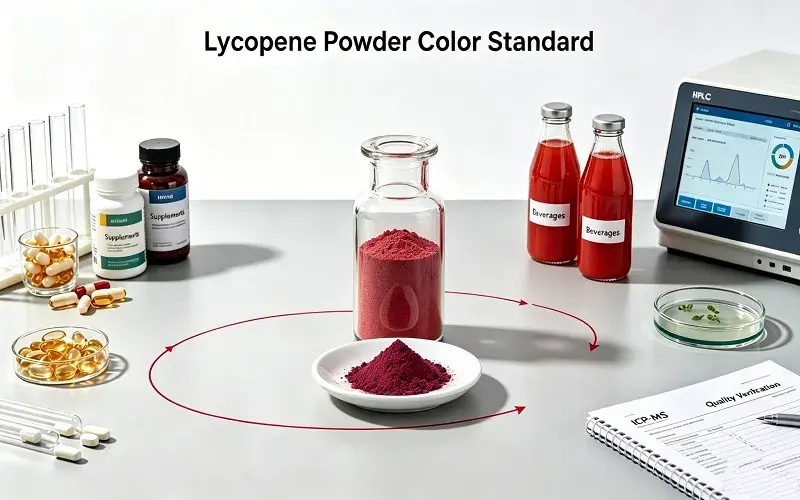
Managers of procurement should set clear acceptance standards that go beyond simple percentages. Our standard certificates of analysis show a number of quality parameters that help protect the image of your business and the consistency of your manufacturing. The trans-isomer percentage and total lycopene powder content are confirmed by HPLC testing. The isomer composition affects bioavailability. Residual solvent screening makes sure that hexane, acetone, and other organic solvents don't get into the fermentation process. These solvents are sometimes used in bad extraction methods.
Heavy metal testing with ICP-MS looks for contaminants like lead, arsenic, cadmium, and mercury that are sometimes found in farming sources but not in fermentation that is properly managed. The microbial limits test checks for yeast, mold, and the total number of cells on a plate. It also checks for pathogens like Salmonella and E. coli. Our microbial specs meet the GMP requirements for food supplements without the need for irradiation, which can break down sensitive carotene molecules.
Procurement Insights: How to Buy Lycopene Powder Effectively?
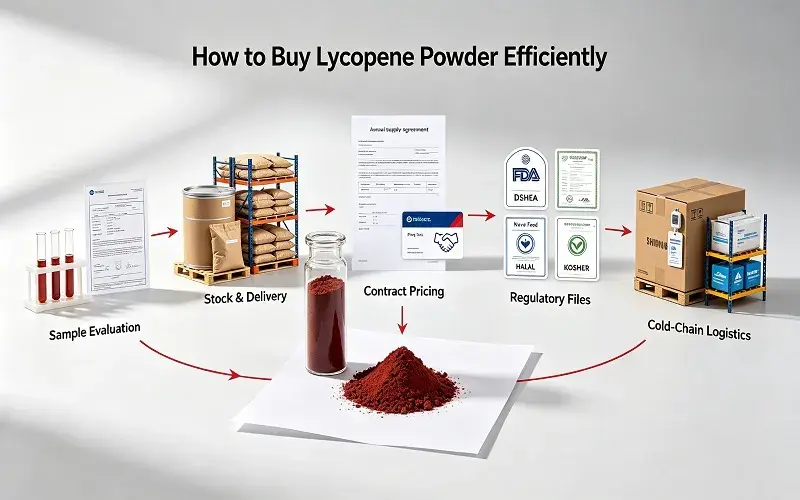
When you strategically source carotenoid ingredients, you have to keep a lot of things in mind, like quality consistency, supply reliability, price competitiveness, and the efficiency of your logistics. After 18 years of working in manufacturing, we know what procurement professionals need to do well.
MOQ Flexibility and Stock Availability
Our usual minimum order size is 25 kg, which is packed in fiber drums with two food-safe plastic divider bags and desiccant packs. This amount is a good starting point for new brands that are making new items without having to commit to too much inventory. We keep our 5%, 10%, and CWS 10% versions of Lycopene Powder in stock, so it only takes 4–8 days from the time an order is confirmed until it is shipped.
Private-label and contract manufacturing clients need at least 500 kg of natural lycopene raw material for custom blends or specifications. This limit makes sure that production runs are efficient while still being affordable for mid-size brands. At this volume level, it becomes cost-effective to make custom concentrations, specialized encapsulation matrices, or unique packaging configurations. For custom projects like formula development, stability testing, and packaging validation, our production schedule allows for lead times of 15 to 20 days.
Before making large agreements, a sample should be evaluated. We give you free 50–100g samples with certificates of analysis so that your R&D team can test for dissolution, make sure the formulation works with the product, and make some initial observations about its stability. A lot of customers ask for more than one specification at the same time, so they can compare performance traits in the context of their particular application.
Pricing Dynamics and Market Positioning
Fermentation-derived lycopene powder is slightly more expensive than tomato-extracted versions because it is more consistent and pure. When you look at the total cost of ownership, which includes less waste from batch rejections, no more rework from quality deviations, and easier quality control testing, the price difference becomes smaller. Our direct factory price gets rid of the markups that distributors add on, giving you competitive quotes that help your margins without lowering the quality of the ingredients.
There are three levels of volume pricing: 100 kg, 500 kg, and 1,000 kg per year. Long-term supply deals are good for both sides. You get better pricing and first choice for allocation, and we get better at planning output and getting raw materials. When compared to spot purchases, annual contracts usually save you 8–15% on costs, which makes your product's economics much better over its lifetime.
Regulatory Documentation and Compliance Support
To get ingredients across borders, they need to be carefully documented so they can get through customs and follow the rules of the country they are going to. Commercial bills, certificates of analysis, health certificates, phytosanitary certificates, and certificates of origin are just a few of the supporting documents that our quality system produces. When these papers come with your package, they keep clearance delays from messing up your production plans.
Dietary supplement applications must be in line with DSHEA for buyers in the US. Our material is approved by the FDA as a food ingredient, and the fermentation source takes into account NDI (New Dietary Ingredient) issues. We keep your FDA registration up to date and give you supporting documents for your master manufacturing records and supplement fact panel development.
European customers have to follow Novel Food regulations that list the official places where fermentation-derived lycopene powder can be bought. Our Blakeslea trispora type meets the required standards, and we provide certificates proving that it is non-GMO and follows all the rules. With HALAL and KOSHER certifications, you can reach more customers in the Middle East and among religious Jews. The certifications are valid for a year to make sure they are always being followed.
Temperature-Controlled Logistics
Because lycopene powder is sensitive to heat, shipping must be done carefully. As standard, our export packaging includes thermal insulation and temperature monitoring tags that keep track of the temperature and humidity during transit. Shipments going to places with hot weather in the summer get extra cold packs or chilled containers as needed. These safety steps keep the integrity of the product from our warehouse to its end destination. This makes sure that the material you receive is the same quality that we approved.
The best places to store things are cool, dry, and out of direct sunlight. Material that is stored properly and still in its original factory packaging stays in good shape for 24 months. Moving the contents to clear, airtight containers while purging them with nitrogen extends their useful life and stops oxidative degradation that lowers color and potency.
Future Trends and Opportunities in Lycopene Applications
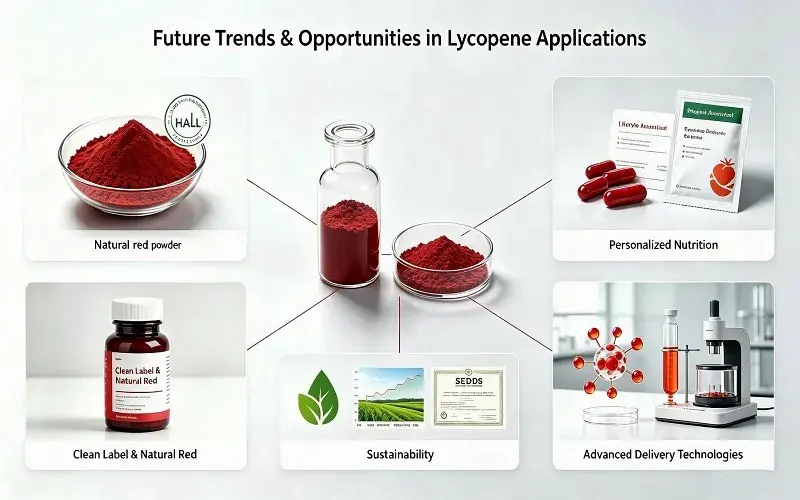
The way the market works means that there are more opportunities for ingredient suppliers and product developers who can guess what consumers will want and how regulations will change over time. Several trends should be taken into account when buying plans that look to the future.
The clean label movement keeps growing and is now affecting all types of products. People carefully read ingredient lists and prefer ingredients that they know over ones that sound like chemicals. Fermentation-derived lycopene powder meets this need and provides both functional and visual benefits, making it a versatile ingredient that makes recipes easier to follow and boosts marketing stories. When brands switch from using synthetic colorants, they find that our natural red pigmentation cuts down on the number of ingredients they need while also adding nutritional value.
Another area of growth is personalized nutrition. Antioxidants are often used by direct-to-consumer supplement brands that make personalized formulas based on genetic tests or lifestyle studies. This move toward personalized supplement plans is helped by the fact that exact lycopene powder dosing can be put into capsule or powder form.
Sustainability approvals are becoming more and more important in deciding what to buy. When compared to growing tomatoes, our fermentation process uses a lot less water and farmland, leaving less of an impact on the environment. Life cycle studies show good carbon intensity measures, which brands that want to be carbon-neutral or climate-positive will like. We keep records that back up environmental product statements and the standards for sustainability reporting.
New technologies are likely to make absorption even better by creating new ways to deliver drugs. Nano-emulsion methods, liposome encapsulation, and self-emulsifying drug delivery systems (SEDDS) are new forms that make absorption rates Our research and development team works with formulators who are looking into these technologies to make technical materials that can be used to build improved transportation systems.
Conclusion
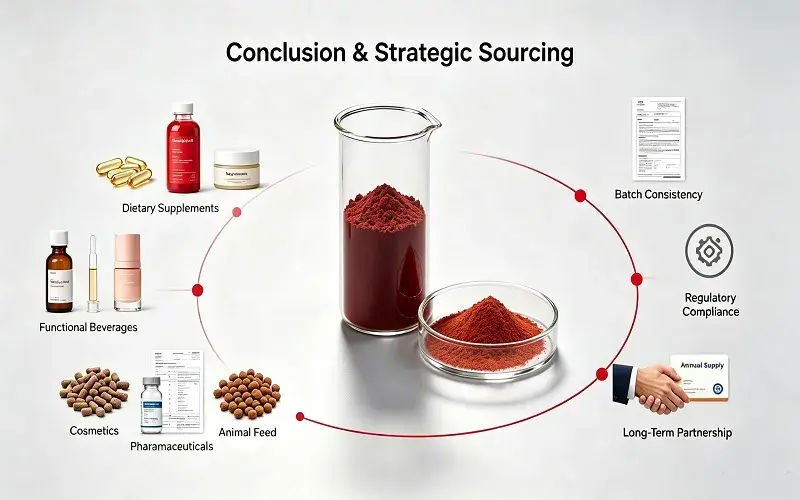
In conclusion, fermentation-derived lycopene powder has a wide range of uses, including in dietary supplements, functional drinks, cosmetics, medicines, and animal nutrition. This is because it has a unique mix of antioxidant power, natural color, and formulation flexibility. To be successful at procurement, you need to match standard grades to the uses you want to use them for, give preference to sellers who offer batch consistency and regulatory compliance paperwork, and build partnerships that support your long-term product development goals. As the market moves toward natural, clean-label ingredients with proven health benefits, brands can meet changing consumer expectations while keeping quality standards and costs low by strategically sourcing reliable carotenoids.
FAQ
1. What concentration should I choose for my supplement formula?
The right measurement varies on how much you want to give and the size of the capsules you have. Standard supplements for prostate health that have 10 to 15 mg of lycopene powder per serving work well with our 10% powder, which needs about 100 to 150 mg of raw material per capsule. Products with 30 mg or more of strength benefit from our 98% grade, which means they need less powder. For the best dispersion performance, beverage apps should always use CWS versions.
2. How does fermentation compare to tomato extraction?
Using Blakeslea trispora for fermentation ensures consistent quality, even when farming factors that affect tomato crops are changed. The process gets rid of pesticide residues and heavy metal contamination risks, keeps the supply stable all year, and makes sure that concentrations are the same from batch to batch. While tomato extraction can be used to make natural-source claims, fermentation is more reliable for commercial manufacturing needs.
3. What certifications support international sales?
We keep our production plant and product lines certified for ISO, HACCP, HALAL, and KOSHER. US FDA approval makes it easier to sell supplements in North American markets. Our paperwork packages come with certificates of analysis, health certificates, and origin certificates that can help you get through customs in more than 40 countries.
Partner With a Trusted Lycopene Powder Supplier
Since 2008, Shaanxi Hisy Biotechnology Co., Ltd. has been a leader in fermentation-derived carotenoids. Our 150 m² building has four dedicated production lines that can make more than 200 metric tons of these Lycopene Powder products every year. Our wide range of specifications—5%, 6%, 10%, and 98% powder, plus CWS 5% and CWS 10% microcapsule formats—solves manufacturing problems in the food and drink, cosmetics, and medicine industries. We solve the most important problems that procurement managers have: consistency from batch to batch using fermentation technology; no problems with sedimentation in drinks because of cold-water dispersibility; full regulatory documentation to support international trade; and flexible MOQs starting at 25 kg for standard grades. You can email our technical sales team at sales@hisybio.com to get free samples with full analytical documentation, talk about custom specifications for your private-label projects, or look into our co-formulation development services.
References
1. Clinton, S.K. (1998). Lycopene: Chemistry, Biology, and Implications for Human Health and Disease. Nutrition Reviews, 56(2), 35-51.
2. Gerster, H. (1997). The Potential Role of Lycopene for Human Health. Journal of the American College of Nutrition, 16(2), 109-126.
3. Rao, A.V., & Agarwal, S. (1999). Role of Lycopene as an Antioxidant Carotenoid in the Prevention of Chronic Diseases: A Review. Nutrition Research, 19(2), 305-323.
4. Stahl, W., & Sies, H. (2003). Antioxidant Activity of Carotenoids. Molecular Aspects of Medicine, 24(6), 345-351.
5. Giovannucci, E. (2002). A Review of Epidemiologic Studies of Tomatoes, Lycopene, and Prostate Cancer. Experimental Biology and Medicine, 227(10), 852-859.
6. Palozza, P., Catalano, A., Simone, R.E., & Cittadini, A. (2012). Lycopene as a Guardian of Redox Signalling. Acta Biochimica Polonica, 59(1), 21-25.