

_1752718207094.png)

How to choose high‑quality soybean isoflavones raw material?
Choosing high-quality Soybean Isoflavones raw material requires careful evaluation of purity, extraction methods, and supplier credentials. Premium raw materials should contain at least 40% total isoflavones—including genistein, daidzein, and glycitein—verified through HPLC testing, with complete Non-GMO certification backed by PCR analysis. Reliable suppliers provide IRMS natural-origin verification reports, thermal stability data showing bioactivity up to 180°C, and comprehensive documentation including allergen statements and batch consistency records. Procurement professionals must prioritize vendors offering flexible customization, rapid sampling capabilities, and robust regulatory compliance to ensure product efficacy and market competitiveness across women's health supplements, functional foods, and nutricosmetic applications.
Core Criteria for Selecting High-Quality Soybean Isoflavones Raw Material
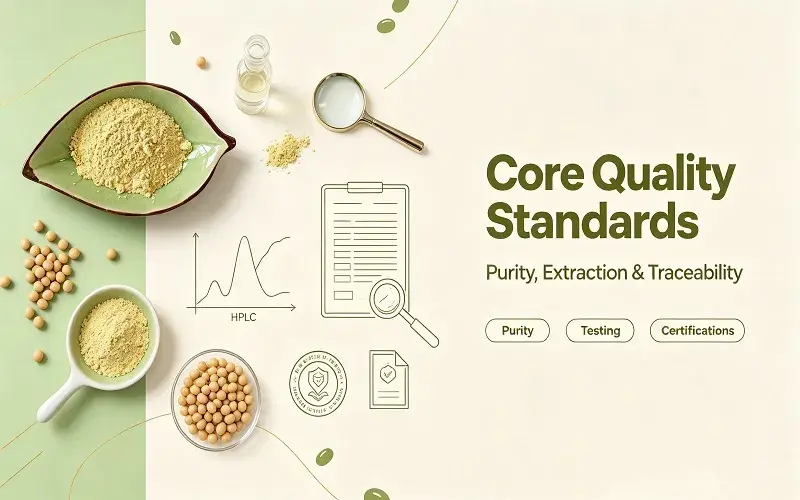
To judge quality, you must first understand the scientific details that set premium soy phytoestrogen extracts apart from inferior ones. To make sure that products always work well and follow the rules, people who work in procurement should set clear goals across a number of quality aspects.
Purity and Isoflavone Concentration Standards
High-Performance Liquid Chromatography (HPLC) tests that measure all six active substances show that premium raw materials have isoflavone levels of 40% or higher. This analytical method gives exact amounts of daidzin, glycitin, genistin, daidzein, glycitein, and genistein, making sure that the mixture stays the same from batch to batch, which is important for keeping the formulation stable. Suppliers that let brands choose their own concentrations—from 20% for entry-level products to 80% for premium lines—give brands that are trying to reach different types of customers more strategic freedom.
Purity includes more than just isoflavone levels; it also includes checking for pollution. ICP-MS testing for heavy metals should show that amounts of lead, arsenic, cadmium, and mercury are well below what is allowed by pharmaceutical standards. Brands are protected from safety problems and legal problems by thorough pesticide residue analysis that includes more than 500 compounds. Gas Chromatography research shows that the amount of leftover extraction solvents, such as ethanol, stays below 5,000 parts per million (ppm), which is safe according to international standards.
Extraction Methods and Processing Integrity
The way the drug is extracted has a big impact on its absorption and treatment effectiveness. The delicate isoflavone structures are kept safe through multiple rounds of gentle liquid extraction, which also keeps their biological activity. Isotope ratio mass spectrometry can be used to prove that the phytochemical profiles that come from non-fermented, non-synthetic extraction from soybean meal and germ are real.
As part of processing integrity, glycoside forms are changed to aglycone structures, which makes uptake rates much higher in human gut systems. Good producers make this change during extraction as efficiently as possible, so the goods are more bioavailable than glycoside-dominant ones. Spray drying technology makes stable powders with controlled particle sizes (usually 80 mesh) that mix easily into different formulation matrices and don't clump or separate.
Certification Requirements and Traceability
Comprehensive approval shows that a provider is dedicated to quality systems and following the rules. For North American markets, FDA registration is a basic level of assurance, and HACCP certification shows that food safety management protocols have been followed. ISO certification, especially ISO 9001 for quality management and ISO 22000 for food safety, shows that you follow a set of rules to be consistent and keep getting better.
PCR-based DNA testing for non-GMO verification addresses both consumer concerns and government requirements, especially in European markets where GMO rules are strict. Suppliers should give full traceability paperwork that shows where the soybeans come from and how they are packaged at the end, such as farming records, extraction batch logs, and quality control test results. This chain of paperwork makes it easy to respond quickly to quality questions and helps business buyers meet their due diligence standards.
Comparative Analysis of Soybean Isoflavones Raw Materials and Market Solutions
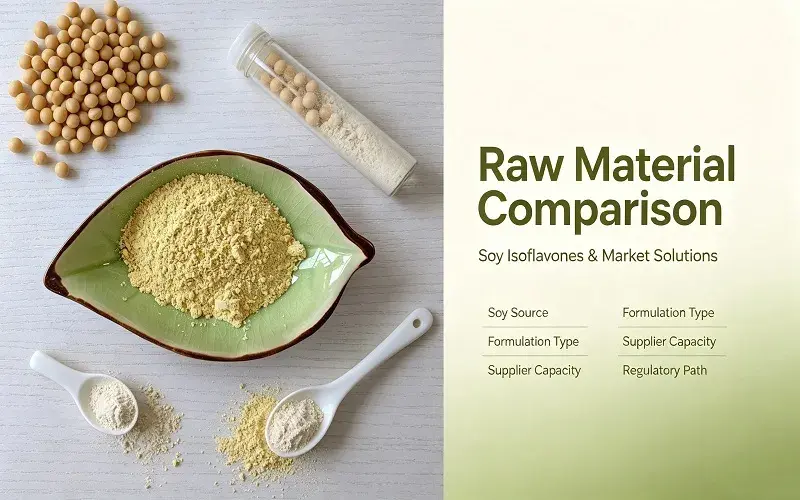
To compare different raw material choices, you need to know how isoflavone extracts stack up against other phytoestrogens and how different providers handle quality and service. Strategic sourcing decisions that are in line with product positioning and market needs are made possible by comparisons that are well-informed.
Comparing Phytoestrogen Sources
Isoflavones can also be found in red clover extract and kudzu root, but materials derived from soybeans are better for business uses. Because they are more thermally stable than other sources, soybean extracts keep their bioactivity even after being processed at high temperatures that would break down other sources. The known regulatory status in major markets shortens the time it takes to get approval compared to botanical sources that aren't used as often and need new food assessments.
When people are familiar with soy-based ingredients, it helps with marketing. This is especially true in North American and Asian markets where eating soy is a cultural practice. Soy is linked to health benefits, which helps brands make women's health products because less education is needed for the market to accept them. Reliability in the supply chain is another economic advantage. Growing soybeans makes them available all over the world at prices that are lower than those for specialty plant crops.
Raw Material Formats and Manufacturing Compatibility
Powder formats rule B2B procurement because they can be used in a wide range of situations. Fine powders with particles that are 80 mesh or smaller spread out evenly in capsule fills, tablet matrices, and beverage systems without needing any extra work. Water-dispersible recipes help plant-based beverage companies make healthy drinks, which need clear solutions that don't precipitate in order for customers to like them.
For some uses, enclosed forms are helpful because they keep sensitive chemicals from breaking down while they are being made and stored. Microencapsulation technology puts protective barriers around isoflavone particles, which makes them last longer and lets the digestive system release them slowly. To get the most stable end product and efficient processing, procurement teams should choose formats that work well with the manufacturing processes they're working with, such as pill-filling lines, tablet compression systems, making liquid beverages, or making topical cosmetics.
Supplier Evaluation and Partnership Criteria
When choosing manufacturing partners, it's not enough just to compare specification sheets; you also need to look at their operating skills and service quality. International buyers care a lot about export experience, especially when it comes to customs paperwork, shipping logistics, and following the rules in the destination markets. Suppliers with established global networks know what paperwork is needed for regional approval and provide it ahead of time.
Production capacity determines whether a partnership is a good idea for brands that are growing. Suppliers with a monthly capacity of 2,000 kg can handle both testing the market for the first time and increasing production on a large scale, all without needing changes from the supplier that introduce risks to the formulation. Rapid sampling, which can give test amounts of 1 kg within 3–5 days, shortens the time it takes to develop a product and get it on the market faster, giving the company a competitive edge.
Brands that are making complicated products can get more strategic value from technical support from R&D teams that can do co-formulation development. To mix soy phytoestrogen isoflavone extracts with things that work well together, like calcium, vitamin D3, or other plant extracts, you need to know a lot about how ingredients combine, how to test for stability, and how to make the best formulation. Suppliers who are ready to sign NDAs protect secret formulas and build the trust that is needed for long-term relationships.
Procurement Strategies: How to Source Premium Soybean Isoflavones for Business Use
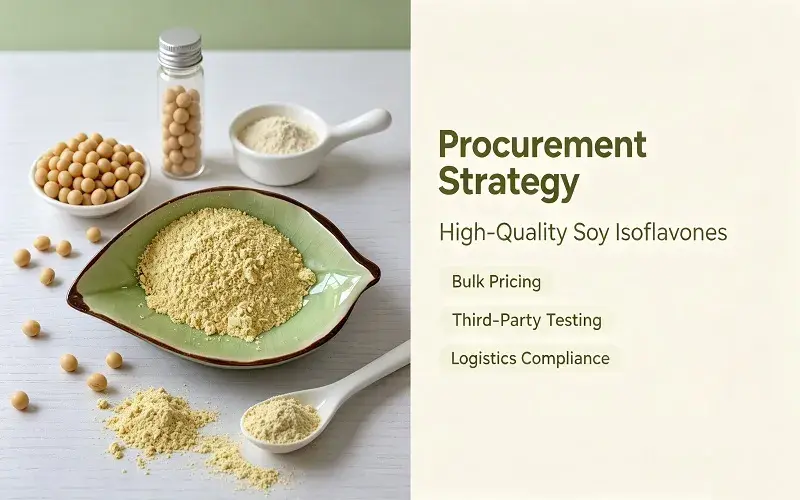
Strategic sourcing makes the most of the value while minimizing the risks that come with buying raw materials from other countries. By using organized evaluation and negotiation strategies, you can get competitive terms without lowering the quality standards.
Bulk Pricing and MOQ Considerations
Volume-based pricing systems credit smart choices about what to buy. When you buy 25 kg drums in bulk, you usually save a lot of money per kilogram compared to buying smaller amounts. This makes annual framework contracts appealing for well-known brands whose demand is predictable. But new brands and product makers can save money by ordering in flexible minimum amounts, starting at 1 kg for pilot production and going up to commercial volumes without any problems.
Partner stability is improved by working out payment terms that meet both the buyer's and the supplier's cash flow needs. Letters of credit protect international transactions, and terms like "net-30" or "net-60" can help you better manage your working capital if you already have a relationship with the other party. When customers commit to a certain amount of goods across multiple orders, they can often get better prices. This rewards loyalty and makes sure there is a steady supply of goods.
Supplier Assessment and Authenticity Verification
To stop adulteration, you need to do more than just look over certificates of analysis for proactive verification. There are ongoing problems in the supplement industry with synthetic genistein being sold as a natural extract, which makes it harder for customers to trust the products and make sure they follow the rules. Demanding IRMS testing results proves that the substance comes from a plant by using isotope analysis to tell the difference between natural botanical chemicals and lab-made ones.
Asking a third-party laboratory to check gives independent confirmation of what the seller says. Reliable testing labs can do a wide range of analyzes, such as HPLC potency testing, heavy metal screening, pesticide residue analysis, and microbial contamination assessment. When you compare third-party results to supplier-provided COAs, you can see if there are any differences that could mean poor quality control or intentional lying.
Site audits, which can be done by the company itself or by outside inspectors, give information about how things are made, stored, and how well quality systems work. Visiting production sites in person shows rules for maintaining equipment, keeping the area clean, and training staff levels that written records can't fully capture. When travel costs or pandemic rules make on-site visits impossible, virtual facility tours through videoconferencing can be a cost-effective option.
Logistics and Compliance Management
International purchasing makes shipping logistics, clearing customs, and following the rules more difficult. Understanding Incoterms, especially the FOB, CIF, and DDP choices, makes it clear who is responsible for paying for shipping costs, insurance, and import taxes. DDP agreements make customs clearance easier by giving responsibility to sellers. However, they might cost more than managing goods directly.
Different countries have different rules about what paperwork is needed for customs. Usually, business bills, packing lists, certificates of origin, and phytosanitary certificates are needed. Suppliers who have worked with exports before put together full packages of paperwork that keep clearance times short and avoid storage fees at ports. Making sure that suppliers are up-to-date on the import rules in target markets is a good way to avoid having shipments rejected or breaking the rules.
For keeping the isoflavone's effectiveness during transport, temperature-controlled procedures are important. By choosing shipping containers with temperature control, you can keep your goods from breaking down in hot areas or freezing in the north during the winter. Moisture-proof and light-proof wrapping, like foil bags inside fiber drums, gives items more safety during long shipping times.
Maximizing Value: Best Practices for Storage, Handling, and Utilization of Soybean Isoflavones Raw Material
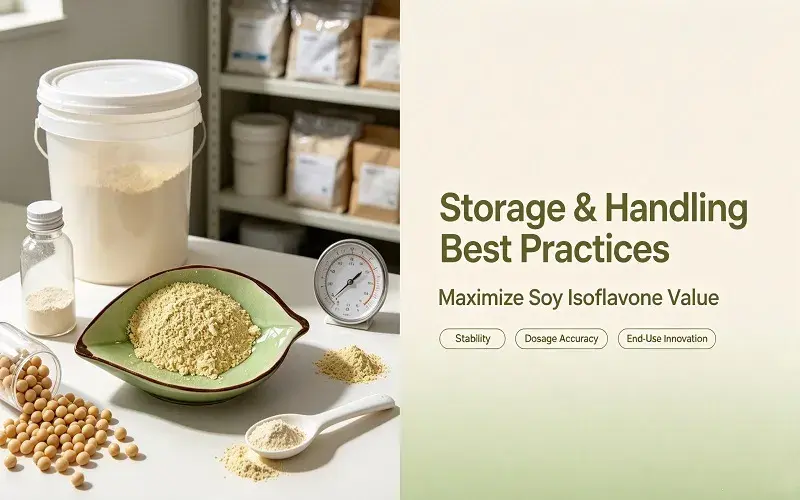
To protect an investment in high-quality raw materials, they need to be handled correctly from the time they are received until the final product is made. Using best practices keeps the product's potency, extends its shelf life, and makes sure it always works the same way.
Storage Conditions and Stability Management
The strength of isoflavones stays the same over the usual 24-month shelf life of quality extracts when stored properly. Temperature decline and moisture absorption that speed up compound breakdown can't happen in cool, dry places between 15°C and 25°C. Direct sunlight shouldn't be allowed in storage areas because it breaks down sensitive phytochemicals even through packaging.
Humidity control stops clumping and microbial growth, which makes powder less safe and less able to flow. Keeping the relative humidity below 60% keeps the powder's ability to move freely, which is important for accurate weighing and even mixing in production. During multiple-batch production runs, sealed containers that are only opened when needed and quickly resealed keep atmospheric moisture to a minimum.
Using the first-in, first-out rule to rotate your inventory makes sure that the oldest items are used up before they go bad. Labeling systems that keep track of receipt dates and lot numbers make rotation more efficient while still allowing for easy tracking for quality checks and government inspections. Testing the strength of kept materials on a regular basis makes sure they are stable and finds any degradation that needs to be fixed in the recipe.
Formulation and Dosage Optimization
To add isoflavone extracts to finished goods, you need to know the best dose ranges and how the ingredients will react with each other. For managing menopausal symptoms, clinical research supports daily amounts of 40 to 80 mg of total isoflavones, which is equal to 100 to 200 mg of 40% standardized extract per serving. For bone health purposes, bigger amounts of up to 90 mg per day may be used, which requires exact math to fit into capsules.
Testing for ingredient suitability stops reactions that aren't expected and could hurt stability or absorption. When isoflavones and calcium compounds mix in water, they can react. To keep the reactive parts separate, formulation strategies like layered tablets or time-release matrices are needed. When making drinks, pH levels are important because acidic environments below pH 4.0 can cause precipitation, which needs emulsifier systems or microencapsulation technology.
Validating the manufacturing method ensures that high-temperature processes don't lower the amount of isoflavones. Quality extracts keep their bioactivity up to 180°C, but longer contact or higher temperatures during extrusion processing may mean that the strength needs to be tested again. Comparing HPLC analysis done before and after production lets you figure out how much processing was lost. This lets you change the label claim in a way that stays in line with regulations.
Market Trends and Innovation Opportunities
Innovating uses for phytoestrogen extracts is possible because of changing consumer tastes. Vegan-friendly women's health products are in high demand because of the plant-based movement. Soybean Isoflavones are seen as natural alternatives to hormone replacement therapy. People who care about their health and want to buy products with clear labels are drawn to brands that use natural ingredients instead of man-made ones.
Personalized diet trends make it possible to put high-end isoflavone ratios that are aimed at particular life stages or health goals. Entry-level products with 20% standardized extracts help with perimenopause at prices that most people can afford. Premium formulas with 80% concentrations give you concentrated amounts to help with severe symptoms. Offering a wide range of products across this spectrum attracts a larger group of customers.
Nutricosmetic applications are growing quickly because people are becoming more aware of the links between what they eat and how they look. When you mix isoflavones with collagen peptides, hyaluronic acid, and antioxidant vitamins, you get a complete anti-aging system that is backed up by studies on how estrogen receptors work in skin tissue. Positioning that says "beauty comes from within" gets high prices and strong brand loyalty.
Conclusion
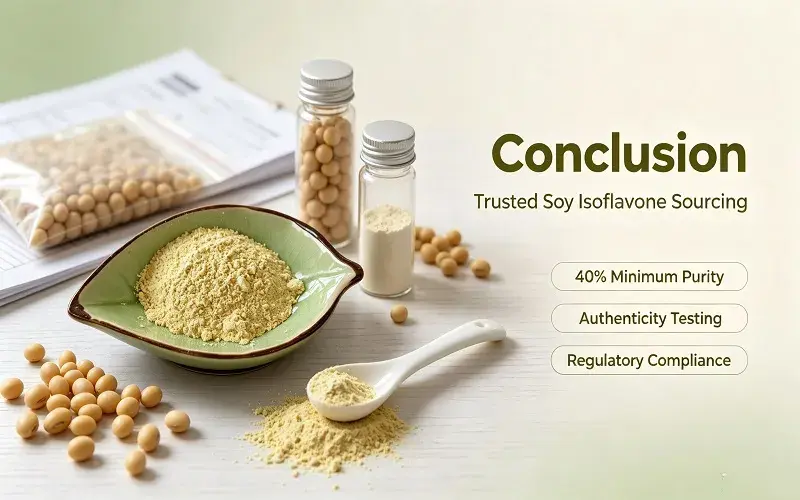
Finding high-quality Soybean Isoflavones raw materials requires a thorough check of technical specs, source abilities, and compliance with regulations. Premium extracts that deliver at least 40% of total isoflavones through natural, non-fermented extraction work well for women's health supplements, functional foods, and nutricosmetic uses. To be successful at procurement, you need to make sure the products are real by using IRMS testing and PCR analysis, and you need to work with certified manufacturers who offer flexible customization, quick sampling, and strong quality systems. Strategic buyers give more weight to suppliers that have a history of exporting, clear paperwork, and expert support that speeds up product development while making sure they follow all global market regulations.
FAQ
1. What purity standards should I expect from premium suppliers?
Premium Soybean Isoflavones raw material must have at least 40% total isoflavones, as determined by HPLC analysis and detailed quantification of all six active compounds. Suppliers must show that the levels of heavy metals are below the limits set by the pharmacopeia, that herbicide residue screening includes 500 or more substances, and that leftover solvent testing confirms that ethanol levels are below 5,000 parts per million. Non-GMO certification backed by PCR analysis and IRMS natural-origin verification reports proves legitimacy and storequirese common practice of adding synthetic ingredients that happens in trade markets.
2. How can I be sure that the seller is real and stop them from falsifying?
Request IRMS isotope test results that use carbon isotope analysis to tell the difference between isoflavones that come from plants and genistein that is made in a lab. Verify by a third-party lab by having independent testing facilities do an HPLC potency analysis and compare the results to the paperwork provided by the supplier. Plan facility audits, either virtually or in person, to look at how things are made, how quality control is done, and where the raw materials come from. Verify the validity of a supplier's certificates, such as FDA registration, HACCP, and ISO standards, by searching the records of the organizations that issued them.
3. What are common regulatory challenges in North American markets?
To follow the DSHEA rules, structure-function claims must be backed up by clinical research data, allergen disclosure statements, and following Good Manufacturing Practices. Baseline FDA standards include registering facilities, making sure that ingredients are what they say they are, and making sure that certificates of analysis match the correctness of labels. Verification of non-GMO goods meets the needs of consumers and retailers, especially natural products shops. Commercial invoices, certificates of origin, and phytosanitary certificates that meet USDA import standards for plant-derived materials must be included in customs paperwork.
Partner with Hisy for Premium Soybean Isoflavones Supply
Our FDA-registered, HACCP-certified, and ISO-certified plant produces organically extracted Soybean Isoflavones base material that always has a potency of at least 40%. Our 18 years of experience making products on 4 specialized lines guarantee consistency from batch to batch. Each batch comes with full COA paperwork that includes IRMS natural-origin verification, Non-GMO PCR analysis, and thermal stability data proving bioactivity up to 180°C. As a B2B customer, you can get samples ranging from 1 kg to 2,000 kg a month, and we can deliver quickly (4–8 days). We also offer R&D co-formulation development with NDA protection. You can get free samples, detailed specifications, and custom quotes from our trusted Soybean Isoflavones manufacturer at sales@hisybio.com. We serve the nutraceutical, functional food, and nutricosmetic industries around the world.
References
1. Messina, M. (2016). "Soy and Health Update: Evaluation of the Clinical and Epidemiologic Literature." Nutrients, 8(12), 754.
2. Setchell, K.D.R., & Cassidy, A. (1999). "Dietary Isoflavones: Biological Effects and Relevance to Human Health." Journal of Nutrition, 129(3), 758S-767S.
3. Vitale, D.C., et al. (2013). "Isoflavones: Estrogenic Activity, Biological Effect and Bioavailability." European Journal of Drug Metabolism and Pharmacokinetics, 38(1), 15-25.
4. Patisaul, H.B., & Jefferson, W. (2010). "The Pros and Cons of Phytoestrogens." Frontiers in Neuroendocrinology, 31(4), 400-419.
5. Chen, M.N., et al. (2015). "Processing Effects on Isoflavone Content and Antioxidant Activity of Soybeans and Soy Products." Journal of Agricultural and Food Chemistry, 63(31), 6872-6880.
6. Rizzo, G., & Baroni, L. (2018). "Soy, Soy Foods and Their Role in Vegetarian Diets." Nutrients, 10(1), 43.