

_1752718207094.png)

How to select high-purity Vitamin A Palmitate Powder?
Selecting high-purity Vitamin A Palmitate Powder requires careful evaluation of potency, supplier certifications, and application compatibility. The gold standard for B2B procurement begins with verifying HPLC test results confirming ≥325,000 IU/g potency, alongside FDA, HACCP, and ISO certifications that guarantee batch-to-batch consistency. Water-soluble beadlet formulations with 80-mesh particle size ensure uniform dispersion in dietary supplements, infant formulas, and functional beverages. Reliable suppliers offer complete documentation packages, including COA with chromatograms, MSDS, and allergen statements, coupled with rapid delivery timelines of 4-8 days and flexible MOQ options starting from 1 kg samples. This comprehensive approach minimises supply chain risk while ensuring regulatory compliance across pharmaceutical, cosmetic, and food-grade applications in competitive global markets.
Key Criteria for Selecting High-Purity Vitamin A Palmitate Powder
Purity Verification and Analytical Standards
Technical knowledge is needed to understand Certificates of Analysis (CoA). The paper needs to show HPLC chromatograms that clearly separate the retinyl palmitate spots and measure their amounts against standards that can be tracked. Buyers should make sure that the testing lab is accredited by ISO/IEC 17025 to make sure that the measurements are correct. We provide test reports from independent, widely known labs, so you don't have to worry about the possibility of changing results in-house.
California Prop 65 compliance is now a must for goods going to the U.S. This rule says that goods must be labelled if they contain detectable amounts of certain chemicals and heavy metals. Upstream screening of raw materials and downstream verification of finished products are both part of our production protocols. This ensures compliance margins above 50% of the threshold limits. This proactive approach keeps buyers safe from recalls and damage to their reputation.
Supplier Credibility and Manufacturing Capabilities
Shaanxi Hisy Biotechnology Co., Ltd. was founded in 2008 and has 150 square meters of contamination-free production space in facilities that are FDA-registered, HACCP-certified, and ISO-certified. Our four dedicated production lines keep an annual capacity of more than 200 metric tonnes, and for special formulations, they can produce up to 2,000 kg per month. This scale makes sure that there is a steady supply, even when demand goes up during certain times of the year, which can affect companies that make infant formula or supplements, getting ready for Q4 launches.
Supplier checks show how mature operations are. A GMP (Good Manufacturing Practices) certification shows that there is documented batch traceability, a maintenance schedule for calibrated equipment, and trained personnel protocols. Our 18-year history in the business shows that we have institutional knowledge that new providers don't have. Buyers of retinyl palmitate powder benefit from formulation support that helps them deal with problems like keeping the pH stable in acidic drinks or keeping the product from oxidising in clear packaging. These services that add value set basic deals apart from strategic partnerships.
Packaging Solutions for Potency Preservation
For samples and trial runs, standard packaging includes 1 kg foil bags. For large orders, 25 kg fibre drums with double plastic liners are used. When shipping across the Pacific or storing things in a warehouse in a humid area, this configuration keeps light and moisture out. Custom packaging, like branded sachets for private-label clients or nitrogen-flushed cases for formulas that react badly to air, can meet specific needs for delivery.
It's impossible to stress how helpful it is for logistics to make things in Xi'an. Being in the middle of China's transportation network makes delivery to major ports possible in 4–8 days, and experienced freight forwarders handle all the paperwork for easy clearance. We provide all the paperwork needed for exporting, such as business bills, packing lists, and health certificates specific to each country. This makes the purchasing process easier for busy supply chain managers who are in charge of many different SKUs.
Comparing Vitamin A Palmitate Powder with Other Vitamin A Forms
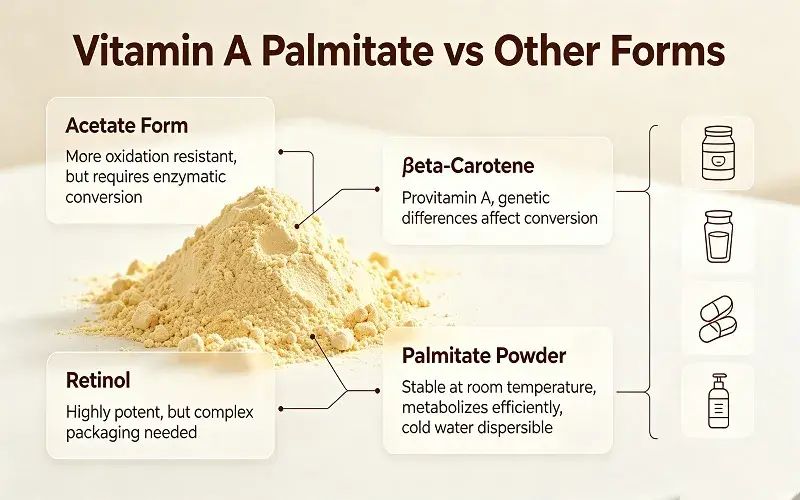
Stability and Bioavailability Trade-offs
Vitamin A acetate is more resistant to oxidation than retinyl palmitate, but it needs to be converted by enzymes during digestion, which could make it less bioavailable in people whose pancreases don't work well. Beta-carotene is a pro-vitamin A that protects against overdose by controlling the conversion process. However, its effectiveness relies on genetic differences that affect the function of the BCMO1 enzyme. Retinol is very powerful, but it needs complex packaging technologies to keep it from breaking down over time.
Our Vitamin A Palmitate Powder beadlet product that dissolves in water makes up for these trade-offs. The palmitate ester structure is stable enough to store at room temperature and still converts very well to active retinol when the body's natural processes happen. With cold-water dispersibility, you don't have to worry about the problems that come with adding oil-based ingredients to ready-to-drink nutrition shakes or quick drink mixes. Because it can be used in so many ways, beadlet technology is chosen by major baby formula brands for their global product lines.
Application-Specific Selection Guidelines
Manufacturers of multivitamin tablets prefer powder types so that there are no problems with movement during the pressing and coating steps. When cosmetic formulators choose ingredients for anti-ageing serums, they need particles bigger than 100 mesh to get a smooth, silky texture. When makers of animal feed weigh cost against solubility, they often choose acetate forms for feed premixes. On the other hand, aquaculture uses emulsions that don't dissolve in water.
To match form to function, you need to know how the final product will be used. We work together with customers to create new products and test their stability under the conditions they choose, such as spray-drying for capsules, hot-fill bottles for drinks, or high-shear mixing for creams. This consultative approach cuts down on the time it takes to get a product to market and makes sure that the formulation works on the first production run.
Procurement and Sourcing Strategies for B2B Buyers
Global Supply Chain Landscape
The North American market depends a lot on European suppliers that stress traceability and non-GMO certifications. On the other hand, Asian manufacturers compete by offering low prices and quick turnaround times. We are in a good position because we offer affordable factory-direct prices and have certifications that meet both U.S. and E.U. standards. Standards set by regulators. Our clients come from more than 30 countries, and the fact that they buy from us again and again shows that the supply chain works well.
OEM and private-label partnerships need more than just standard catalogue items. When clients ask for custom IU concentrations, like 250,000 IU/G for paediatric formulas or 500,000 IU/G for animal uses, we can try formulation changes on a small scale before committing to full production. When an NDA (Non-Disclosure Agreement) is signed, it guards proprietary blend specs. This addresses intellectual property concerns that stop people from talking about new ideas with suppliers who aren't as well-known.
Cost Optimisation Without Compromising Quality
By starting with minimum order sizes as low as 1 kg for samples of retinyl palmitate powder, you can avoid the financial risk of agreeing to 25 kg drums before you're sure the product will work in your application. Free samples come with full paperwork, like a COA, MSDS, TDS, and allergen statements, so that quality assurance and research and development teams can carefully look over them inside the company. This "try-before-you-buy" model cuts the time it takes to qualify suppliers from months to weeks.
Bulk price systems reward people who coprovitamining a lot. For well-known goods that are used at regular intervals each month, full-container orders that take advantage of tiered discounts make economic sense. Our clear pricing shows the actual cost of making the product, not multiple markups for distributors. This helps you make more money while keeping the end product competitive. Currency hedging options and longer payment terms help seasonal businesses plan their finances and absorb changes in cash flow.
Quality Control and Supplier Verification Protocols
Checking documents is more than just looking at the CoA test data. Buyers should ask for batch-specific paperwork that includes production date codes, studies that show when the food will go bad, and advice on how to store it properly. We keep digital archives that can be accessed through safe client portals. This makes it possible to get information right away during governmental checks or audits by customers. This makes people more likely to believe that quality management continues throughout the whole span of a product.
On-site facility inspections give you the best view of how things are run. We encourage potential clients or their chosen third-party inspectors to do audits of our work to show that they trust our methods for preventing pollution, our equipment testing procedures, and our training programmes for employees. Virtual tours use high-definition video recordings of production workflows and quality testing procedures to help people do their research before they decide to travel abroad.
Best Practices for Using and Handling Vitamin A Palmitate Powder
Dosage Recommendations Across Applications
Dietary supplements usually have between 1,500 and 3,000 IU per dose for adults, which is the same as the daily suggested amount and gives the supplement a buffer against breaking down over time. Codex Alimentarius standards tell formula makers what minimum levels to use per 100 kcal. This means they have to do exact calculations of potency that take into account the losses that happen during spray-drying and reconstitution. Cosmetics use amounts between 0.1 and 1.0% in finished goods, which strikes a balance between how well they work and how much they might irritate the skin.
Our expert support team helps you figure out the best dose for your target audience by taking into account rival products, regulatory claim substantiation requirements, and your target audience. This consulting service is very helpful for figuring out how to balance marketing claims, label accuracy standards, and good production practices that protect consumers.
Safety Protocols and Storage Conditions
Vitamin A palmitate powder needs to be kept in a cool, dry place that is out of direct sunshine. The best conditions are when the temperature is below 25°C and the relative humidity is below 60%. This can be done in climate-controlled buildings or with desiccant-lined packing for smaller quantities. When containers are opened, they should be resealed right away after use. For long-term storage of partial drums, nitrogen blanketing is recommended.
Standard operating procedures for handling people include basic PPE like dust masks for powder transfer tasks and gloves to protect skin from coming into contact with concentrated material. Acute exposure is not very dangerous, but long-term exposure needs air systems that meet health standards for workers. We provide detailed MSDS paperwork that includes first aid steps, how to clean up a spill, and how to properly dispose of waste that is in line with environmental laws in all areas.
Formulation Compatibility Considerations
Blending patterns affect how homogeneous the final result is. For pill formulas, Vitamin A Palmitate Powder should be added during the dry mixing phase. To keep the beads from breaking, gentle tumbling should be used instead of high-shear mixing. Pre-dispersion in a small amount of water before diluting into large batches is helpful for beverage applications because it makes sure that the substance dissolves completely without clumping. If you use non-water-soluble forms in cosmetic emulsions, you have to add an oil phase. Our CWD (cold water dispersible) technology gets rid of this need.
Testing for incompatibility with other formula parts keeps costly delays in reformulation at bay. Problems that often come up are oxidation sped up by trace metals, degradation caused by acidic environments, and competing reactions with other vitamins that dissolve in fat. We do stability tests that are similar to your manufacturing process and packing setup. This gives you data to back up your shelf-life claims when you submit them to regulators.
Conclusion
When looking for high-purity vitamin A palmitate powder, you need to carefully check its potency, look at the supplier's credentials, and look at how well it works in different situations. To do B2B buying right, you need to find a balance between analytical rigour (checking HPLC test results) and regulatory compliance, along with smart seller partnerships that offer technical support, flexible MOQs, and reliable delivery dates. Understanding the differences between pharmaceutical, food, and cosmetic grades keeps regulatory issues from happening, and comparing the stability profiles of different vitamin A derivatives makes sure that the formulation works well. Shaanxi Hisy Biotechnology Co., Ltd. is the perfect example of a supplier: they have FDA-registered facilities, have been in the business for 18 years, can produce 200 metric tonnes of goods each year, and have all the paperwork they need to support global delivery. People who work in procurement and who put a high value on quality, stability, supply chain reliability, and expert formulation support will find these qualities essential for staying ahead of the competition in the nutrition, cosmetics, and pharmaceutical markets.
FAQ
1. What defines "high-purity" in vitamin A palmitate powder specifications?
High-purity ratings usually mean that the potency is more than 325,000 IU/G, which can be proven by HPLC analysis. They also mean that the heavy metal content is below USP standards (lead < 2 ppm, arsenic < 1 ppm). Pharmaceutical-grade materials also meet microbiological standards set by USP <61> and <62>, with Salmonella and E. coli levels below 1,000 CFU/g and no other bacteria present. Vitamin A palmitate powder food-grade specifications are based on FCC rules, while cosmetic grades stress uniform particle size and no smell or discolouration that could affect the look of the finished product.
2. How can buyers verify supplier authenticity and product quality?
Real suppliers give third-party test reports from ISO 17025-accredited labs, facility certifications (FDA registration, GMP, HACCP, ISO), and full traceability documentation, such as records of each batch of production. Requesting free samples with CoA, MSDS, and TDS documents lets you check them on your own before placing bulk orders. On-site audits or virtual facility tours show how things are run, and examples from past clients who have used similar solutions show how well they work in real life.
3. Can vitamin A palmitate powder be used across multiple industries?
Water-soluble beadlet formulations are very flexible and can be used to make food supplements, baby formula, functional drinks, cosmetic serums, and premixes for animal feeding. The success of an application depends on how well the particle size, dispersibility, and potency levels are matched to the manufacturing process. For pharmaceutical uses, materials must meet USP standards. For food items, they must meet FCC standards, and for makeup, sensory qualities are most important. Talking to providers that offer application-specific technical help is the best way to make sure that different types of products are compliant with regulations and that formulations work well together.
Reach out to Hisy for a premium vitamin A palmitate powder supply.
Shaanxi Hisy Biotechnology Co., Ltd. has been making high-quality Vitamin A Palmitate Powder for over 18 years and is ready to meet your needs. Our facilities are FDA-registered, HACCP-certified, and ISO-certified. They make ≥325,000 IU/G water-soluble beadlet formulations that are supplied within 4–8 days. They come with full paperwork, such as a COA with HPLC chromatograms, MSDS, and allergen statements. Our Xi'an-based production capacity of 2,000 kg per month guarantees a stable supply chain, whether you need 1 kg samples for formulation trials or full-container bulk sales with custom potency concentrations. You can talk to our technical team about your application markets and tree samples or set up a facility audit by emailing sales@hisybio.com. We help with formulations that are covered by NDAs and offer legal advice for the US and EU markets and flexible package choices that can be used for cosmetics, pharmaceuticals, and food-grade products. Work with a reliable manufacturer that is dedicated to providing consistent quality and helpful customer service in all global markets.
References
1. Ball, G. F. M. (2006). Vitamins in Foods: Analysis, Bioavailability, and Stability. CRC Press, Boca Raton, FL.
2. Combs, G. F., & McClung, J. P. (2017). The Vitamins: Fundamental Aspects in Nutrition and Health (5th ed.). Academic Press, Cambridge, MA.
3. Dwivedi, M., & Kumar, P. (2015). Stability and bioavailability of vitamin A palmitate in fortified foods. Journal of Food Science and Technology, 52(7), 3931-3941.
4. United States Pharmacopeial Convention. (2022). USP-NF: United States Pharmacopeia and National Formulary. Rockville, MD.
5. Weber, P., & Bendich, A. (2014). Vitamin A: Biochemistry and physiological roles. In Handbook of Vitamins (4th ed., pp. 229-276). CRC Press.
6. World Health Organization. (2019). Guidelines on Food Fortification with Micronutrients. WHO Press, Geneva, Switzerland.