

_1752718207094.png)

How to test capsaicin content in chili extract powder?
Testing capsaicin content in chili extract powder is crucial for ensuring product consistency, regulatory compliance, and formulation accuracy across pharmaceutical, industrial, and nutraceutical applications. The gold standard involves High-Performance Liquid Chromatography (HPLC), which precisely quantifies individual capsaicinoids like capsaicin and dihydrocapsaicin. For suppliers offering Natural Capsaicin Powder, robust analytical methods guarantee batch-to-batch reliability, supporting procurement decisions for wholesale buyers and OEM clients who demand transparent quality verification. We'll explore proven testing techniques that address your specific B2B quality control needs.
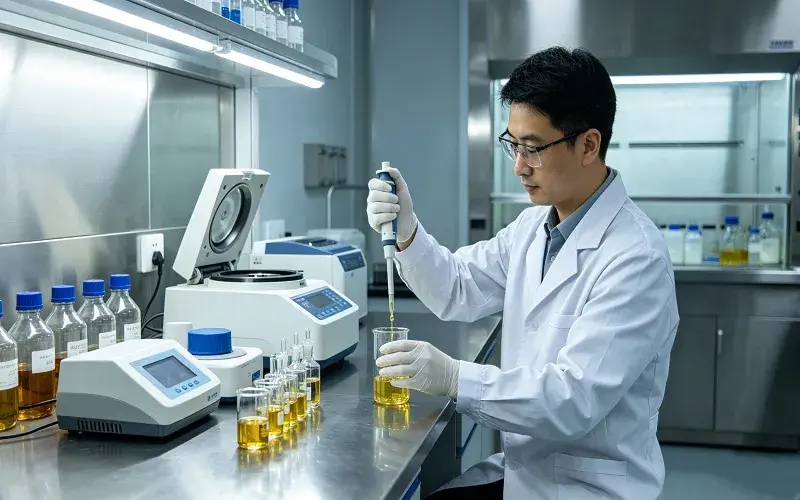
Challenges in Testing Capsaicin Content: Limitations of Traditional Methods
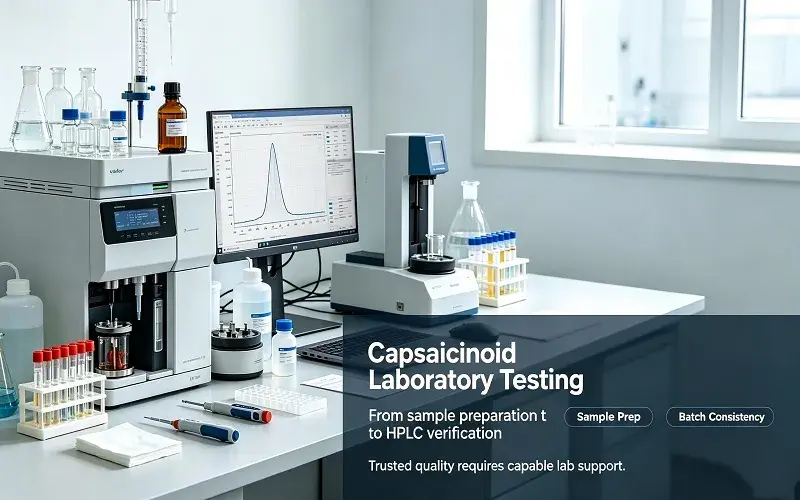
Traditional ways of analyzing data have set standards for the industry, but they also have problems that make the B2B supply chain less efficient and quality assurance programs less effective.
Complexity and Time Intensity of HPLC
High-Performance Liquid Chromatography is still the most accurate way to profile capsaicinoids, but it needs specialized tools, trained workers, and longer processing times. Extractions with methanol or acetonitrile are used to prepare samples. Next are the steps of filtration and dilution, which take 30 to 45 minutes per sample. It takes 15 to 25 minutes for the chromatographic run itself, plus time for the column to get back to normal between samples. This response time makes it hard for suppliers to test releases because they have to handle multiple production runs every day. When sellers don't have enough HPLC capacity, it takes longer for pharmaceutical procurement teams to get the Certificate of Analysis data with the full chromatograms they need. For basic systems, the cost of the equipment is more than $50,000, which makes it hard for smaller producers to provide verification data.
Variability in UV Spectrometry Results
Ultraviolet spectrophotometry is faster, but it is less accurate because it measures total absorption at characteristic wavelengths (usually 280 nm) and can't tell the difference between capsaicinoid substances in Capsicum annuum capsaicin powder. Readings are thrown off by matrix interferences caused by flavonoids and pigments that were removed at the same time, especially in samples from red chili types. Buyers can't check the capsaicin-to-dihydrocapsaicin ratios that are important for medicinal formulas because the images aren't clear enough. When buyers of industrial coatings for antifouling purposes only get information from sellers who use UV methods without also doing HPLC analysis, they end up with batch differences. The method is still good for quick screening, but it can't be used as the only quality control measure for important tasks.
Cost Barriers for Small-Scale Producers
For full capsaicinoid profiling, third-party lab testing costs between $200 and $500 per sample. This puts financial pressure on suppliers who give OEM clients small pilot quantities. This way of setting prices isn't good for buyers who are looking at more than one provider or running recipe tests with custom capsaicinoid ratios. Some producers cut back on how often they test in order to save money, which leads to quality differences that mess up customers' production schedules. When looking for nutraceutical vitamins or private-label formulas, buyers have to weigh the costs of testing samples against the chance of getting material that doesn't meet their needs. These economic problems show how important it is to work with well-known suppliers who have their own labs and split the cost of testing among many large production runs.
Modern Methods to Test Capsaicin Content in Chili Extract Powder
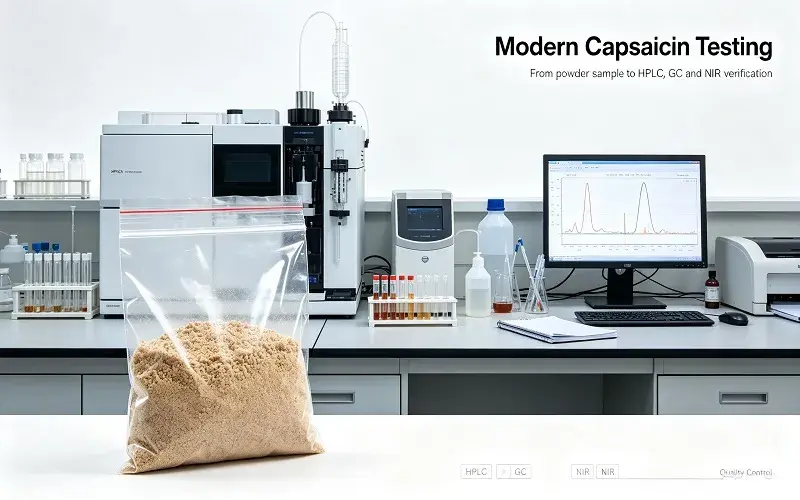
As technology has improved, buying teams now have more analytical choices that balance speed, accuracy, and usefulness for a wide range of testing situations.
HPLC: The Industry Gold Standard
For USP and EP pharmacopeia compliance, High-Performance Liquid Chromatography is a must-have because it accurately separates and measures individual capsaicinoid compounds. The method uses reverse-phase columns (usually C18) with mobile phases that are a mix of acetonitrile and water. Capsaicinoids are found at 280 nm UV bands or by fluorescence measurement for better sensitivity. Modern HPLC systems with autosamplers can handle 50 to 100 samples every day, which is enough to meet the needs of pharmaceutical companies and industrial buyers who have to handle large amounts of purchases. The chromatogram shows the amounts of capsaicin, dihydrocapsaicin, and other capsaicinoids, such as nordihydrocapsaicin. This gives a full compositional fingerprint. Capsaicinoids from petroleum have very different peak patterns than capsaicinoids from natural botanical extracts. This detailed profiling helps buyers spot fake products. To make sure the method is accurate, quality assurance teams should ask for chromatograms with relative standard deviations below 2% and baseline clarity between major spots.
Gas Chromatography for Residual Solvent Analysis
HPLC measures the amount of capsaicinoids, and Gas Chromatography (GC) checks for a similar quality issue: chemicals left over from the extraction process. This risk is completely eliminated by supercritical CO2 extraction, but methods that use ethanol or hexane need to be checked to make sure that the residual levels meet ICH Q3C guidelines. GC-FID (Flame Ionization Detector) or GC-MS (Mass Spectrometry) tools can find methanol, ethanol, hexane, and acetone at amounts of parts per million. Usually, pharmaceutical buying rules say that hexane must be less than 290 ppm and methanol must be less than 3,000 ppm. If an industrial buyer is looking for materials that can be used in food-grade applications, they should ask for GC residual solvent certificates that prove the materials are solvent-free. This is especially important when dealing with sellers who use cheaper extraction technologies. The nitrogen-flushed packaging keeps the solvent-free integrity of the capsaicinoid during storage and transport and also stops it from oxidizing.
Near-Infrared Spectroscopy for Rapid Screening
Near-Infrared (NIR) Spectroscopy provides real-time, non-destructive research that can be used for quality control on the line in high-volume production settings. The method finds molecule vibrations in the 780–2,500 nm range and uses chemometric calibration models to connect spectral marks with capsaicinoid amounts. NIR devices give results in 60 seconds, which means that choices can be made right away about when to release incoming raw materials. The method works best when it is calibrated against HPLC reference data that covers the concentration range that is expected. Large pharmaceutical companies and industrial coating makers benefit from putting NIR into continuous production lines because it cuts down on the amount of work that needs to be done in labs for testing while still keeping an eye on quality. The price of the technology ranges from $30,000 to $80,000, based on what it can do. For buyers who want to consolidate suppliers and standardize specs, it is a smart investment. To keep their accuracy, calibration models need to be checked against HPLC on a regular basis, since the sources of raw materials change with the seasons.
Quality Control and Validation Practices
More than capsaicinoids are measured in comprehensive testing. They also include heavy metal testing, microbial research, and particle size verification. ICP-MS can detect minuscule concentrations of lead, arsenic, mercury, and cadmium below 10 ppm, the USP heavy metal limit. Microbe tests include Total Plate Count, Yeast, Mould, E. coli, and Salmonella protect pharmaceutical and nutraceutical usage. The particle size distribution study validates the 177-micron 80-mesh specifications. This ensures topical compositions and coatings have equally distributed particles. OEM customers producing their own formulations should request capsaicinoid retention data for 24–36 months in nitrogen-flushed storage. Third-party testing from recognised labs may help buyers achieve FDA registration or organic verification certificates. The Certificate of Analysis should provide test methodologies, specification limitations, and actual findings for each significant parameter. This clarifies quality and aids purchasing acceptance.
Ensuring Consistency and Reliability: Case Studies in Capsaicin Content Testing
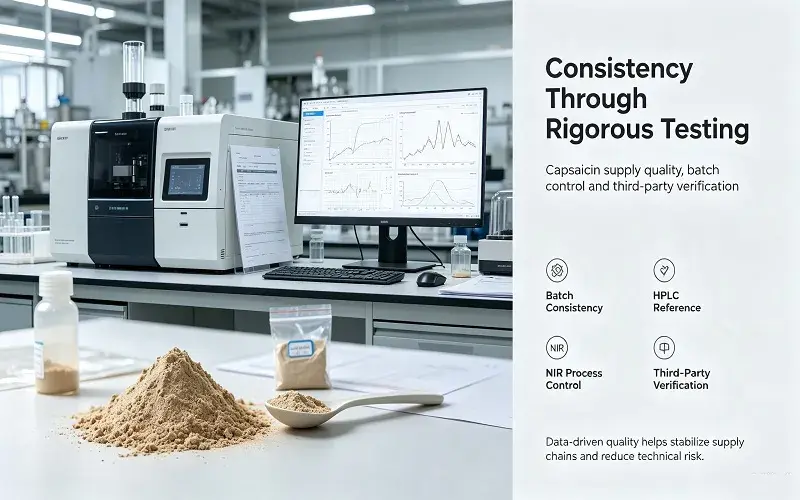
Real-life examples show how strict testing standards can help the supply chain and make operations run more smoothly for both buyers and sellers.
Pharmaceutical Supplier Achieving Batch Consistency
A company that sells pharmaceutical-grade capsaicin to companies that make transdermal patches used statistical process control (SPC) to keep an eye on all of its production runs. Over the course of 18 months, they lowered the coefficient of variation from 8.3% to 1.7% by testing capsaicin-to-dihydrocapsaicin ratios at three stages of production: after extraction, after crystallization, and after final packaging. Because of this, their pharmaceutical clients didn't have to make expensive changes to the formulas and were able to stay in line with regulations across multiple production sites. The supplier bought two HPLC systems that work 16 hours a day. This cut the time it took to go from collecting samples to giving out certificates of analysis to less than 12 hours. Pharmaceutical buying teams felt more confident and were able to increase order quantities from three-monthly shipments to agreed-upon yearly amounts. This kept prices stable and ensured priority placement during supply shortages across the industry. The case shows how investing in critical research can directly lead to business success and customer growth.
OEM Client Implementing International Standards
An eco-friendly antifouling coating maker and a capsaicin provider worked together to come up with custom particle size guidelines that make marine paint spread better. As part of the partnership, NIR calibration models had to be tested against HPLC reference standards. This allowed quality checks to be made in real time while bulk powder was being blended. The buyer set acceptable conditions that included capsaicinoid levels within ±2% of goal levels and particle distribution of 200 mesh or more. The supplier changed the milling equipment and set up in-process NIR scanning every 15 minutes. For critical parameters, they recorded capability indices (Cpk) above 1.67. This method, which was based on data, cut the number of customer complaints from 4.2% to 0.3% and helped the coating manufacturer pass their ISO 9001 certification audit. The partnership shows how aligned testing methods can benefit both parties, allowing new products to be made while keeping technical risk under control.
Continuous Monitoring and Third-Party Verification
The best companies that sell Capsicum annuum capsaicin powder have complete quality control systems that include both internal testing and regular checks by a third party, which. By sending samples to approved ISO/IEC 17025 labs every month, internal HPLC accuracy is confirmed by comparisons of proficiency tests. Carbon-14 isotopic analysis done every three months verifies the botanical origin and protects the brand's reputation from claims of synthetic adulteration. Environmental tracking programs check source chili crops for heavy metals and pesticide residues and take corrective steps before harvest to avoid specification failures. This proactive quality culture solves the main problems that pharmaceutical procurement teams and industrial buyers have, which are that they have to pay a lot of money when defects in raw materials aren't found in time. Initiatives for continuous growth based on test results make commodity markets unique in a way that price competition alone wouldn't be able to.
Procurement Insights: How to Select Natural Capsaicin Powder Based on Content Testing
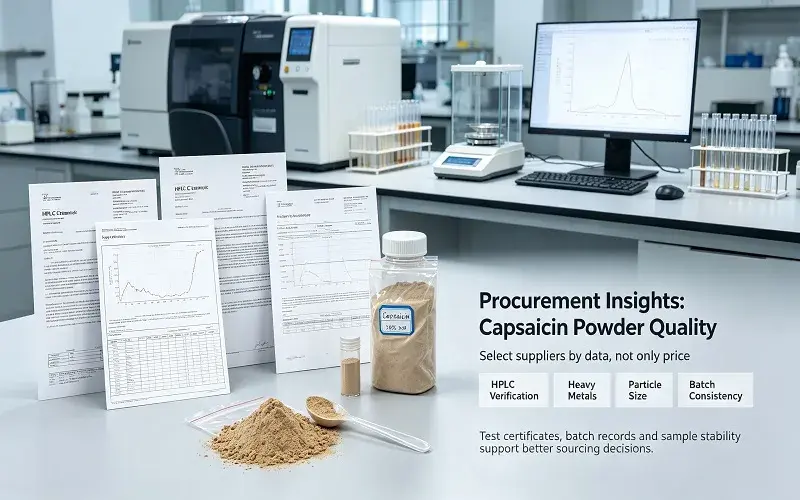
When making strategic sourcing choices, you need to look at sellers in more ways than just their prices. One important factor is how analytical they are, which is a key selection criterion.
Key Metrics for Supplier Evaluation
Total capsaicinoid content (≥97%), individual capsaicin concentration (≥55%), and dihydrocapsaicin amounts (≥20%) should be required by procurement standards instead of being suggested as normal values. Ask for five consecutive Certificates of Analysis that show consistency from batch to batch and figure out the mean and standard deviation for important parameters. Suppliers whose capsaicinoid ratios have relative standard deviations less than 2.5% show that they have good process control. Check that the Certificate of Analysis papers have HPLC chromatograms that show the peak purity values, baseline precision, and retention times. These technical details help your quality team check the truth of the method and look for signs of possible data manipulation. It is easier to predict formulations from suppliers who give 80-mesh particle size specs along with distribution curves than from those who only give nominal numbers. Heavy metal certificates should show real values found instead of vague "below limit of detection" comments. This shows that the analytical method is sensitive enough for materials used in pharmaceuticals.
Comparing Natural Extract versus Oleoresins
Natural Capsaicin Powder with at least 97% total capsaicinoids is 15-20 times more potent than normal oleoresins, which usually only have 5–10% capsaicinoids. This means that less formulation is needed and regulation paperwork is easier to fill out. For pharmaceutical uses that need to follow USP 46-NF41, crystalline capsaicinoid forms are needed instead of oleoresin mixes that have lipids, proteins, and carbs that make processing harder. People who buy industrial coatings benefit from crystalline powders being more oxidatively stable than oleoresins, which tend to go bad when stored in nitrogen-flushed conditions. When you do a cost analysis, you should look at the price per gram of active capsaicinoid instead of the cost per kilogram of the raw materials. This will show that premium crystalline extracts often have lower manufacturing costs even tho they cost more to buy. When nutraceutical brands try to position themselves as having clean labels, customers are more likely to accept Natural Capsaicin Powder instead of "chili oleoresin" on ingredient lists. This supports premium pricing strategies at retail.
Sample Evaluation and Supplier Qualification
Ask for analytical samples that come with full testing results that include the capsaicinoid profile, heavy metals, microbiology, particle size distribution, and any residual solvents. Instead of specially made "showcase" versions, qualified providers give samples that are exactly the same as the production material. Use your own formulation models to do side-by-side comparison dissolution or dispersion tests. Check both the initial performance and stability over increased aging periods. Suppliers who are sure of their quality often offer pilot quantities (5–10 kg) at normal prices instead of demanding immediate commitment to full container loads. This method lowers the risk of formulating new products for OEM clients who want to find unique capsaicinoid ratios for transdermal delivery systems or specific repelling uses. Talk to your suppliers about secrecy deals that will keep your secret formulation information safe and let their R&D teams improve particle size or give you advice on how to make the mixture dissolve better. These partnerships create competitive benefits that transactional commodity sellers can't match.
Conclusion
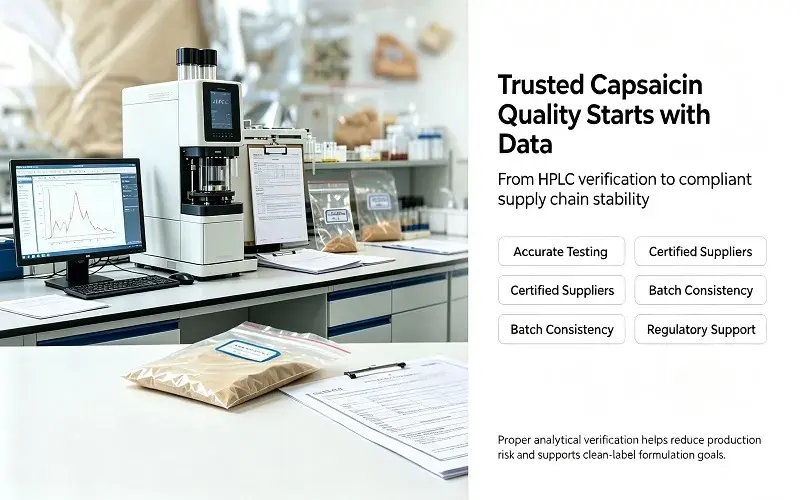
Accurately testing capsaicin content is the basis for quality control, following rules, and a reliable supply chain in the nutraceutical, pharmaceutical, and industrial sectors. Modern testing methods, such as HPLC, provide the accuracy needed to confirm the specs of Natural Capsaicin Powder, and new technologies, such as NIR spectroscopy, make operations run more smoothly. Teams in charge of buying things should give more weight to suppliers who can show they can do thorough testing, clear documentation, and consistency from batch to batch, which can be shown by detailed Certificates of Analysis. Investing in better analytical verification saves production processes further down the line from disruptions that cost a lot of money and problems with the law. Strategic relationships with approved providers that offer at least 97% total capsaicinoids will help your recipes meet performance goals and help with regulatory applications and "clean label" positioning.
FAQ
1. What is the most reliable method for testing capsaicin content?
High-Performance Liquid Chromatography (HPLC) is still the best and most widely used way to accurately measure the amount of capsaicin and dihydrocapsaicin, and other capsaicinoid compounds. This method sorts compounds into groups based on their chemical qualities, and the results meet the standards set by the USP and EP pharmacopeias, which are needed for medicinal uses.
2. How can I detect synthetic capsaicin adulteration?
The capsaicinoid ratios in real Natural Capsaicin Powder can be seen in HPLC chromatograms. Usually, the ratios of capsaicin to dihydrocapsaicin are between 1:1 and 2:1. The profiles of synthetic versions are simpler, with single molecules like nonivamide taking up most of the space. Carbon-14 isotopic research proves for sure that the substance comes from plants, telling the difference between plant-based products and synthetics made from petroleum.
3. What testing frequency ensures consistent quality?
Every production batch from reputable suppliers is tested using HPLC to see how much capsaicinoid it contains. Heavy metals, residual solvents, and microbiology are also tested on a regular basis based on risk. Instead of generic specification sheets, buyers should ask for Certificates of Analysis for particular batch numbers. This way, the real material received can be tracked and checked.
Partner with Hisy for Verified Natural Capsaicin Powder Supply
Shaanxi Hisy Biotechnology Co., Ltd. has been making medicines for 18 years and has the ability to analyze them to pharmaceutical standards. They make Natural Capsaicin Powder that has at least 97% total capsaicinoids, which has been proven by USP 46-NF41-compliant HPLC tests. Our in-house lab handles more than 500 samples every month, making sure that each batch is the same. This keeps your production plans and regulatory reports safe. For full transparency, we provide full Certificates of Analysis that include HPLC chromatograms, residual solvent verification, heavy metal screening, and microbiology reports. Our annual capacity of more than 200 metric tons across four specialized production lines ensures a steady supply for both big pharmaceutical orders and small pilot batches that help OEMs develop new formulas. When you get free samples, they come with full analytical paperwork that lets you compare them directly with the companies you already work with. Get in touch with our technical team at sales@hisybio.com to talk about your specific capsaicinoid ratio needs, custom particle size requirements, or needs for formulation support. They are backed by FDA registration, HACCP, and ISO certifications that make the process of finding a source easier.
References
1. Collins, M.D., Wasmund, L.M., & Bosland, P.W. (1995). Improved method for quantifying capsaicinoids in Capsicum using high-performance liquid chromatography. HortScience, 30(1), 137-139.
2. Reilly, C.A., Ehlhardt, W.J., Jackson, D.A., Kulanthaivel, P., Mutlib, A.E., Espina, R.J., Moody, D.E., Crouch, D.J., & Yost, G.S. (2003). Metabolism of capsaicin by cytochrome P450 produces novel dehydrogenated metabolites and decreases cytotoxicity to lung and liver cells. Chemical Research in Toxicology, 16(3), 336-349.
3. Barbero, G.F., Palma, M., & Barroso, C.G. (2006). Determination of capsaicinoids in peppers by microwave-assisted extraction-high-performance liquid chromatography with fluorescence detection. Analytica Chimica Acta, 578(2), 227-233.
4. Constant, H.L., Cordell, G.A., & West, D.P. (1995). Noniva,, a constituent of Capsicum oleoresin. Journal of Natural Products, 58(12), 1925-1928.
5. American Pharmacopeia Convention. (2023). Capsaicin Monograph. United States Pharmacopeia 46-National Formulary 41. Rockville, MD: USP Convention.
6. Kozukue, N., Han, J.S., Kozukue, E., Lee, S.J., Kim, J.A., Lee, K.R., Levin, C.E., & Friedman, M. (2005). Analysis of eight capsaicinoids in peppers and pepper-containing foods by high-performance liquid chromatography and liquid chromatography-mass spectrometry. Journal of Agricultural and Food Chemistry, 53(23), 9172-9181.